Amavasya: A Moment of Stillness, Closure, and Renewal
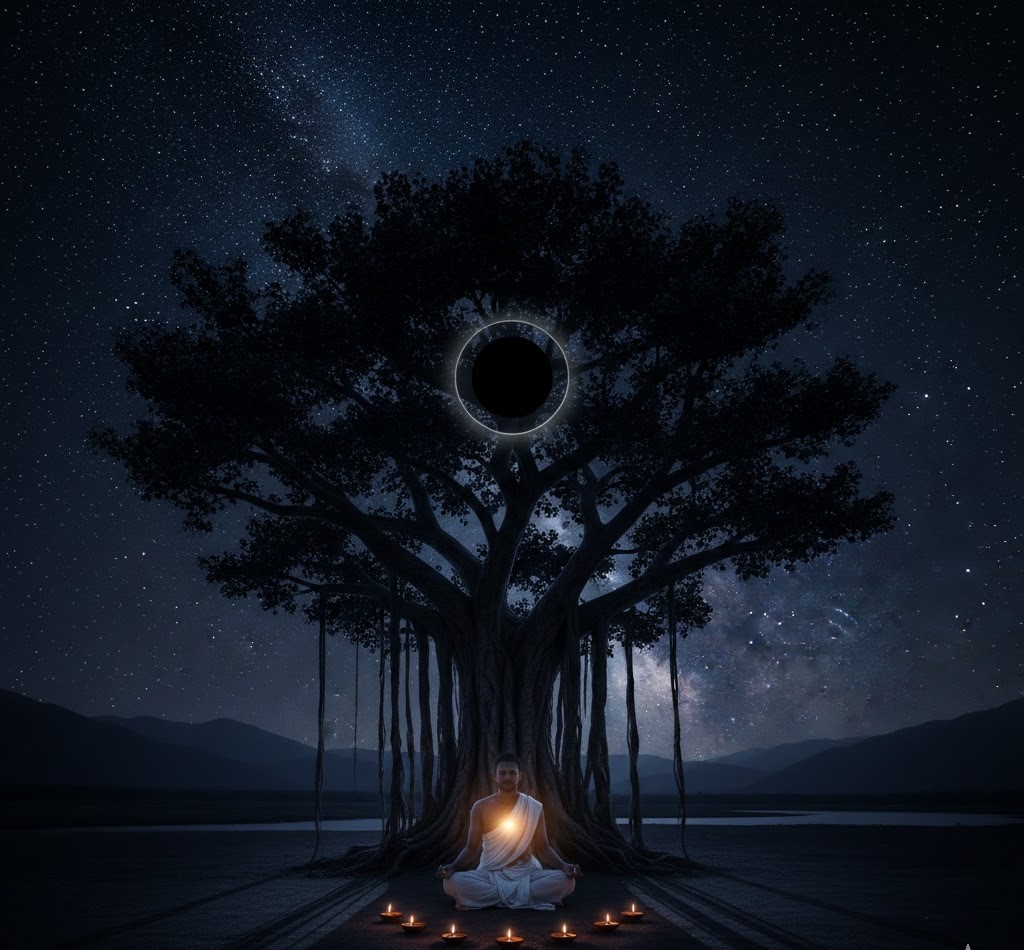
Welcome to another easy insight from our Time & Cosmic Cycles series. Today, we explore Amavasya – the moonless night that ancient wisdom celebrates as a moment of quiet pause and subtle inner renewal.
🌑 What is Amavasya?
Amavasya, also called the New Moon Day, marks the completion of a lunar cycle. It is the moment when the Moon is positioned in such a way that its bright side is not visible from Earth, making the sky appear moonless. It is the natural pause between two lunar cycles – a time the scriptures consider powerful for silence, offering, and inner cleansing.
🌚 What Happens on Amavasya?
Amavasya is the final day of Krishna Paksha, when the visible portion of the Moon reduces to zero. With the ending of this cycle, the next day begins Shukla Paksha, the brightening phase.
Regional Calendar Differences
Astronomically, Amavasya marks the start of a new lunar cycle. Yet, different regions follow different month-counting traditions:
- South Indian (Amānta) system: the month ends on Amavasya, and a new month begins the following day.
- North Indian (Pūrṇimānta) system: the month ends on Purnima, placing Amavasya in the middle of the month.
These variations simply reflect regional customs. The spiritual meaning of Amavasya remains the same everywhere – a time of stillness, release, and quiet renewal.
📜 Scriptural Roots
The significance of Amavasya is deeply rooted in early Vedic and classical Hindu texts:
- The Atharva Veda (8.10.24) refers to Amavasya as Darsha, the day suitable for specific monthly rituals.
- The Yajur Veda prescribes the Darsha-Purnamasa rituals performed on Amavasya and Purnima.
- The Manusmriti (4.25) lists Amavasya as a day fit for honoring ancestors.
- The Bhagavata Purana (5.20-21) explains the Moon’s movement and how its phases-particularly the disappearance of its light-structure the flow of time.
These references show that Amavasya has been an integral marker in spiritual and ritual life since the earliest layers of Vedic culture.
🔍 Why is Amavasya Significant?
Across traditions, Amavasya is seen as a day that naturally supports inwardness and clarity.
🪔 A Day for Honouring Ancestors
Amavasya is closely linked with Pitru Tarpana, the offering made to ancestors.This connection is described in the Garuda Purana, which explains that the subtle energies on this day make remembrance and gratitude more effective.
🪔 Inner Stillness and the Pancha-Tattva Connection
In the traditional understanding of the pancha-tattvas (five natural energies), Amavasya is associated with a rise in tamas – not in the negative sense, but as a gentle, grounding darkness that encourages quietness and inwardness.
Just as the sky becomes moonless, the inner world naturally settles. This makes Amavasya especially supportive for:
- meditation
- fasting
- self-reflection
- simple healing practices
Because this energy is inward-pulling, tradition avoids beginning new ventures on Amavasya. It is a day meant for completing, releasing, and resetting – not for initiating.
🪔 Cultural and Ritual Importance
Many monthly vratas, temple rituals, and traditional practices are aligned with Amavasya. Many important observances fall on Amavasya. Examples include:
- Diwali / Kartik Amavasya
- Shani Amavasya
- Mahalaya Amavasya (during Pitru Paksha)
✨ Tatvamaya™ Insight
Amavasya teaches that every cycle must pause, become still, and empty itself before a new beginning can unfold.