Ekadashi: A Sacred Pause in the Rhythm of Time
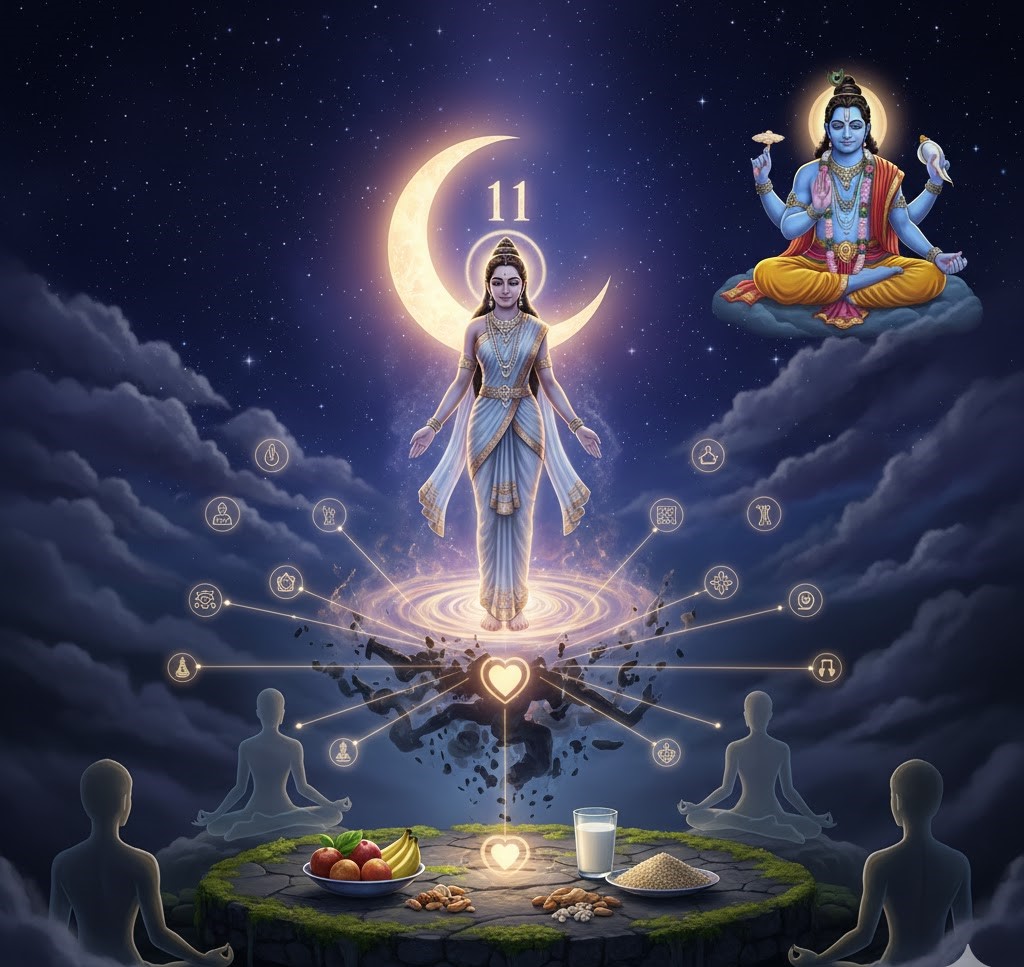
Tatvamaya Series – Time & Cosmic Cycles
Welcome back to our journey through the rhythms of time. With each step, we uncover how cosmic movements quietly shape inner awareness.
Twice every lunar month, a quiet yet powerful day arrives. It is called Ekadashi, the eleventh tithi of the Moon.
Simple in appearance yet profound in depth, Ekadashi is a sacred vrata — a vow of fasting and remembrance. It is especially dear to Lord Vishnu, and many scriptures lovingly call it Hari-vasara, the day of Lord Hari.
It is not merely a ritual. It is a rhythmic return to awareness. 🌿
🌱 What Is Ekadashi?
In the Hindu lunar calendar, Ekadashi falls on the eleventh day in both:
- Shukla Paksha, the waxing phase
- Krishna Paksha, the waning phase
It is traditionally observed with fasting, prayer, mantra, and inward reflection.
But why the eleventh day?
📖 The story from the Puranas
The Padma Purana narrates that a fierce demon named Mura once disturbed cosmic harmony. From the divine radiance of Lord Vishnu emerged Ekadashi Devi, who destroyed the demon. Pleased with her, Lord Vishnu declared that the 11th lunar day would be known as Ekadashi and would be very dear to Him; those who fast and worship on this day are freed from sins and uplifted.
The story symbolically teaches that Ekadashi helps destroy inner demons such as indulgence, distraction, and inertia.
Why Eleven?
In Sanskrit, Ekadashi simply means “eleven” – the eleventh day.
The Bhagavata Purana and later teachers explain that we have ten senses: five senses of knowledge (seeing, hearing, smelling, tasting, touching) and five organs of action (hands, feet, speech, organs of excretion and reproduction). The “eleventh” is the mind (manas), which directs all the other ten.
Ekadashi is therefore the day to gently withdraw the ten senses from excess and guide the eleventh, the mind, toward the Divine. It is a day of alignment and conscious restraint.
What Is a Vrata?
A vrata is a vow, the inner resolve. It is not just a fast.
If one avoids food but spends the day in anger or distraction, the observance remains incomplete. True Ekadashi combines simplicity in diet with calmness in speech, purity in thought, and remembrance of the Divine.
Why Avoid Grains?
Many people think Ekadashi just means “eat less,” but the traditional rule is more specific: avoid grains and beans (anna and certain pulses) on this day.
The Brahmanda Purana and other texts relate a story where the personification of sin, Papa‑purusha, sought refuge when Ekadashi began freeing devotees from negativity. Lord Vishnu allowed him to reside in grains on this day. For this reason, consuming grains on Ekadashi is symbolically said to hinder purification.
Therefore, devotees avoid rice, wheat, lentils, and beans, and instead take simple non-grain foods such as fruits, milk, roots, and nuts according to their capacity.
The teaching is symbolic. By avoiding heavier foods, the body becomes lighter and the mind more inward, aligning with the true purpose of Ekadashi.
💡The Spiritual and Scientific Perspective
In traditional time‑keeping, each tithi has a particular subtle influence; Ancient seers observed, around Ekadashi the Moon’s effect on the mind is at a kind of threshold, making it a good day to shift from outward activity to inward silence.
The body and mind are connected: what we eat, how much we sleep, what we see and hear – all of this shapes our inner state. This is a psychosomatic (body‑mind) understanding found across yoga and Ayurveda.
On Ekadashi, lightening the digestive load conserves energy and supports clarity. When digestion rests, awareness grows.
Modern research on periodic fasting and simple eating also shows benefits for bodily balance, which harmonizes well with this ancient vrata, even though science does not speak of Ekadashi by name.
📚The three levels of observing Ekadashi
Ekadashi allows flexibility according to health and capacity.
- Physical
Keep meals light and sattvic. Avoid grains and beans, reducing heavy spices and excess salt to keep the body calm and clear. - Mental
Reduce noise, limit digital and worldly inputs, practice short periods of silence (mauna), and engage the mind in japa(chants), reading, or prayers. - Spiritual
Turn the mind again and again toward the source of existence – through mantra, remembrance of Lord Vishnu, or simple heartfelt prayer.
Among all Ekadashis, Nirjala Ekadashi is known for its strict observance, where some devotees fast even without water under proper guidance. Yet tradition always emphasizes balance and suitability.
✨ Tatvamaya Insight
Ekadashi is not about punishing the body. it is about lightening the body so that the mind can rise.
By simplifying food and quieting the senses, we gently train the “eleventh”, the mind, to rest not in restlessness but in remembrance.
In the quiet rhythm of the lunar cycle, Ekadashi becomes a sacred pause, a day when the body softens and the inner light grows clearer.