Krishna Paksha – The Phase When the Moon Shrinks
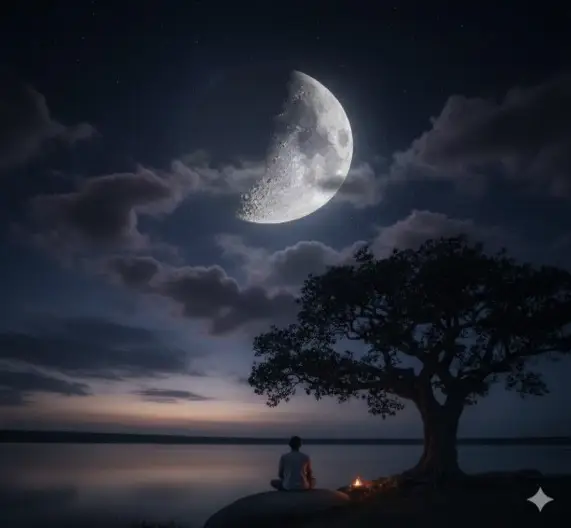
Welcome back to our Tatvamaya™ series on Time & Cosmic Cycles. Come, let’s uncover another piece of ancient wisdom in the easiest way possible. Today, we explore a concept everyone hears about but not everyone fully understands: Krishna Paksha.
Krishna Paksha – The Phase When the Moon Shrinks
Krishna Paksha is the half of the month – the time when the Moon slowly becomes smaller in the sky after the Full Moon.
It begins the day after Purnima(Full Moon) and continues until Amavasya(New Moon).
So, in simple words: Krishna Paksha is the time when the Moon’s light reduces day by day.
Why is it called “Krishna” Paksha?
In Sanskrit:
- Krishna means dark or fading.
- Paksha means fortnight or phase.
So, Krishna Paksha literally means: “The darker half of the lunar month.”
Why does the Moon appear to “shrink”?
The Moon is not actually shrinking. It is the angle of sunlight falling on the Moon that keeps changing as the Moon moves in its orbit around the Earth. Because of this shifting angle, we see less of the Moon’s sunlit surface each day – and this decreasing visibility is what we call Krishna Paksha.
Inner Meaning: What does this phase represent?
Our ancestors observed not just the outer Moon, but also the inner state it supports. As the Moon’s light reduces, we are encouraged to:
- let go of what is no longer needed
- slow down
- reflect within
- release emotional or mental clutter
- embrace quietness
So Krishna Paksha is seen as a gentle time for inner cleaning and quietness.
Why is Krishna Paksha important?
Many spiritual practices, observations, and rituals are performed during this time because the energy of these days naturally supports:
- meditation
- fasting
- calming the mind
- emotional stability
- self-discipline
- subtle spiritual practices
Because the outer light reduces, the mind is believed to settle more easily. This makes it an ideal time for sadhana and reconnecting with oneself.
Festivals and Rituals During Krishna Paksha
Several important observances fall in this phase. For example:
- Maha Shivaratri (14th day of Krishna Paksha in Phalguna)
- Kalabhairav Ashtami
- Pitru Paksha (ancestral remembrance rituals in Bhadrapada)
These practices align beautifully with the inward, reflective energy of Krishna Paksha.
Traditional View
Culturally, Krishna Paksha is usually considered less favorable for new beginnings such as marriages or starting major ventures. Instead, it is respected as a time for humility, completion, and deep inner work.
Tatvamaya™ Insight
“Krishna Paksha gently reminds us that as outer light fades, our inner light has a chance to shine brighter” — Tatvamaya™.