What is a Tithi?
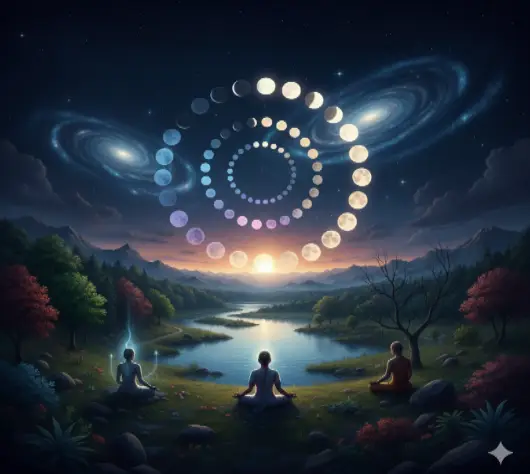
Welcome back to our Tatvamaya™ series on Time & Cosmic Cycles. Today, let’s explore another beautiful concept “Tithi” in reference to the Lunar Month.
Have you noticed how Hindu festivals don’t follow dates, but follow the moon?
That’s because behind every festival lies a Tithi. Let’s discover what a Tithi really is-and why the moon, not the clock, decides the day.
What is a Tithi?
⭐The Moon Cycle of the Hindu Calendar
In the Hindu way of timekeeping, a day is not measured only by sunrise and sunset,
It is also counted by the moon’s position relation to the sun. This measure of the day using the moon’s position is called a Tithi.
⭐The Meaning of a Tithi
The word Tithi (तिथि) comes from the Sanskrit root “तिथ् (tith)”, which means: “to happen,” “to occur,” or “a specific point in time.”
In simple words, Tithi means a “moon-day.”
It is the time it takes for the Moon to move a certain distance ahead of the Sun in the sky.
In the Hindu calendar, Tithi is the basic unit of time.
A new Tithi begins each time the Moon moves 12 degrees further away from the Sun in its orbit around the Earth. In other words, when the Moon’s position changes by 12° relative to the Sun, a new Tithi starts.
⭐Why do we follow the moon?
Our ancestors noticed that whenever the moon changed, life on Earth changed with it-tides rise and fall, plants shows different growth patterns, and even our mood and energy change. Because we are a part of nature, the moon’s rhythm naturally influences us too. The moon’s pull shapes our inner rhythm – our mind, our energy, and even our behaviour.
So instead of fixed dates, the Hindu calendar follows Tithis, the moon’s phases, to stay aligned with this natural flow. Festivals and rituals are not fixed by date, but by the moon’s phase.
For example:
Ekadashi occurs on the 11th Tithi of each fortnight.
Purnima is the Full Moon day.
Amavasya is the New Moon day.
Festivals like Janmashtami, Navratri, and Diwali are aligned with specific Tithis.
In essence: the moon helps us stay in tune with the natural rhythm of life – outside and within.
⭐ How many Tithis are there?
A Hindu month has 30 Tithis:
- 15 in Shukla Paksha – the bright half, when the Moon grows from new to full.
- 15 in Krishna Paksha – the dark half, when the Moon wanes from full to new.
Because the moon’s speed changes slightly every day, a Tithi can be shorter or longer than a normal 24-hour day. This is why Hindu festival dates sometimes shift on the English calendar.
Traditional Panchangas (Hindu almanacs) mark the exact start and end times of each Tithi using astronomical calculations.
⭐ Spiritual Essence
Each Tithi carries its own spiritual vibration. Some are ideal for action and worship, while others invite rest, reflection, or silence. . A Tithi is not just a date – it’s a bridge between astronomy and spirituality. By following Tithis, life stays in rhythm with the Moon – and therefore, with nature itself. Because of this, Tithis became the foundation of the Hindu calendar. When we understand Tithis, we stop forcing things on days when the energy is low,
and we make the most of days when nature supports growth.
⭐Tatvamaya™ Insight:
A Tithi is the moon’s way of telling us the right time for the right action.
“When time flows with awareness, every day becomes divine.” – Tatvamaya™