‹ Back to the libraryLibraryIsha Upanishad ईशावास्योपनिषद्
Sunrise over the Himalayas, golden light falling on forests, rivers and villages

Upanishads · Shukla Yajurveda · Book 1 of the Tatvamaya Library

Isha Upanishad

ईशावास्योपनिषद्

Everything belongs to the Divine. Live fully, and hold it all lightly.

18
verses
5
parts
25
minutes to read

In one minute

The Upanishad opens with a bold idea: everything in this world is filled with the Lord (Isha). Nothing is truly yours; it is all on loan. So enjoy life, but the way a guest enjoys a home: gratefully, without grabbing.

Then it says something surprising for a spiritual book: keep working, live a full hundred years, and your work will not trap you. Running away is not the answer.

In the middle it describes the Self, the deepest you. It does not move, yet it is faster than the mind. It is far, yet it is near. It is inside everything and outside everything. Whoever sees all beings in the Self, and the Self in all beings, can no longer hate anyone.

It warns against two extremes: chasing only worldly success, and chasing only spiritual knowledge. The wise hold both together. It ends with a prayer from someone at the end of life, asking the Sun to remove its golden lid so the truth can be seen, and asking Agni, the sacred fire, to lead us on the good path.

Three big ideas

  1. Everything belongs to the Divine. Use the world, don't own it. Greed is forgetting whose things these are.
  2. Act fully, without being trapped. Work is not the problem. Clinging to its results is.
  3. One Self in all. When you see yourself in everyone, fear, grief and hatred lose their ground.
Before we begin

The peace invocation

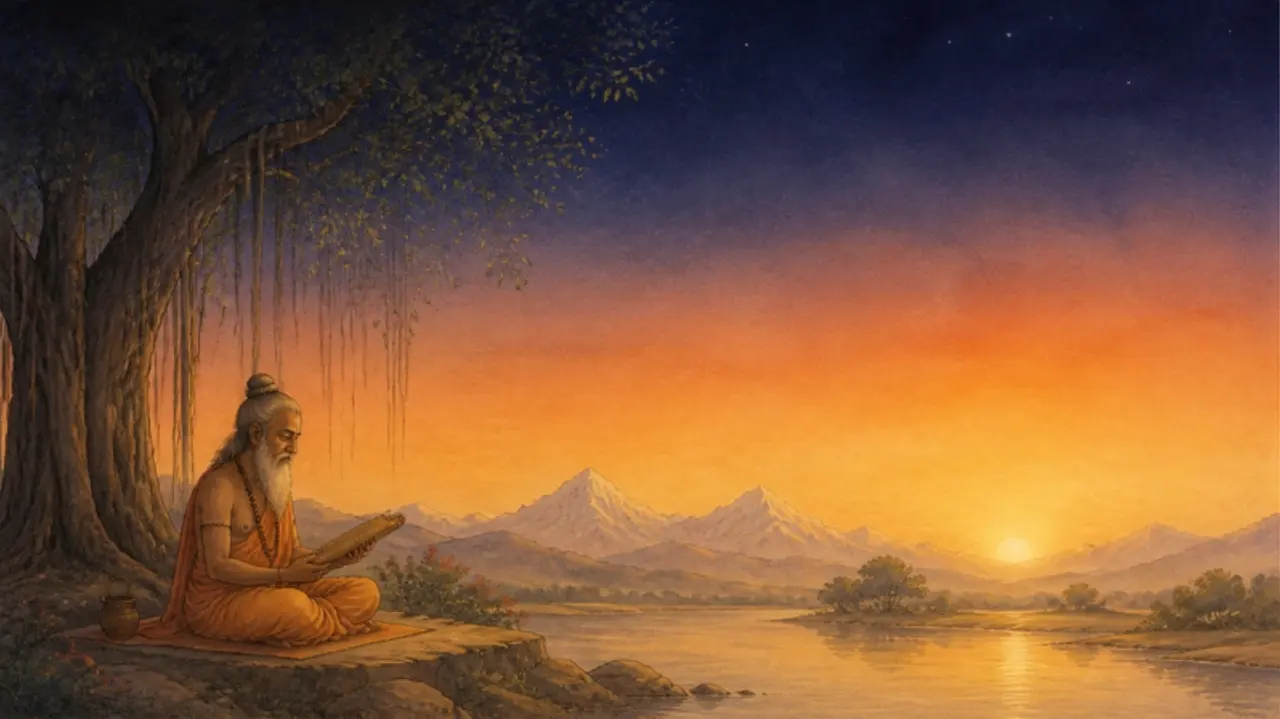
A sage seated under a banyan tree at sunrise, reading from a palm-leaf manuscript

The Isha Upanishad is traditionally recited with this prayer before and after. It is also the opening verse of chapter 5 of the Brihadaranyaka Upanishad (5.1.1).

ॐ पूर्णमदः पूर्णमिदं पूर्णात्पूर्णमुदच्यते।पूर्णस्य पूर्णमादाय पूर्णमेवावशिष्यते॥ॐ शान्तिः शान्तिः शान्तिः॥
oṁ pūrṇam adaḥ pūrṇam idaṁ pūrṇāt pūrṇam udacyate / pūrṇasya pūrṇam ādāya pūrṇam evāvaśiṣyate / oṁ śāntiḥ śāntiḥ śāntiḥ

MeaningThat is complete. This is complete. From the complete, the complete comes out. Take the complete away from the complete, and the complete is still there. Om, peace, peace, peace.

What it is saying"That" is the infinite reality behind everything. "This" is the world we see, and you. Both are whole. Nothing is lost when the world comes out of the infinite, just as the infinite does not become less by giving.

A modern way to see itLight one diya from another. The second flame is complete, and the first has lost nothing. Mathematicians find the same strangeness in infinity: take infinity away from infinity and infinity can still remain.

Why it starts herePeace is said three times, traditionally for peace in the body, peace with the world around us, and peace with forces beyond our control.

Word by word
Word by word
oṁ
Om, the sacred sound
pūrṇam
full, complete
adaḥ
that
idam
this
pūrṇāt
from the full
udacyate
comes out
pūrṇasya
of the full
ādāya
taking away
eva
only
avaśiṣyate
remains
śāntiḥ
peace
Deeper meaning

Deeper meaningMany teachers read this as a statement about you. Your true nature is already complete. Nothing you gain adds to it and nothing you lose takes from it. Much of our restlessness comes from feeling incomplete and hunting for the missing piece outside. The prayer begins by reminding us that nothing is missing.

Part 1 · Verses 1–3

Everything belongs to the Divine

The first three verses give the whole teaching in practical form: how to own, how to work, and what happens when we forget who we are.

Verse 1

ईशा वास्यमिदं सर्वं यत्किञ्च जगत्यां जगत्।तेन त्यक्तेन भुञ्जीथा मा गृधः कस्यस्विद्धनम्॥
īśā vāsyam idaṁ sarvaṁ yat kiñca jagatyāṁ jagat / tena tyaktena bhuñjīthā mā gṛdhaḥ kasya svid dhanam

MeaningEverything in this world, everything that moves, is filled with the Lord. So enjoy it, but let go of the need to own it. Don't be greedy. Whose wealth is it anyway?

What it is sayingPicture the whole world wrapped in the presence of the Divine, the way a room is filled with light. If everything is His, then nothing is finally mine. The verse does not say "don't enjoy". It says enjoy by letting go: hold things lightly, and you can actually enjoy them.

A modern way to see itThink of a book from a library. You can love it, read it three times, and still return it. You enjoyed it fully because you never mistook it for your property. The trouble starts when we treat a borrowed life as an owned one: comparing salaries, scrolling through other people's holidays, wanting what is theirs. "Whose wealth is it anyway?" is a good question to ask before every purchase and every envious scroll.

RememberUse it, enjoy it, don't grab it. It was never yours to keep.

Mahatma Gandhi said that if every other scripture were lost and only this first verse survived, Hinduism would live forever.

Word by word
Word by word
īśā
by the Lord
vāsyam
to be covered, filled
idam
this
sarvam
all
yat kiñca
whatever
jagatyām
in the world
jagat
whatever moves
tena
by that
tyaktena
renunciation, letting go
bhuñjīthāḥ
enjoy
mā
do not
gṛdhaḥ
be greedy
kasya svit
whose, after all?
dhanam
wealth
Deeper meaning

Deeper meaningAdi Shankaracharya reads "covered" as covering the world with the thought of the Lord, so that we see the Divine where we used to see only objects to grab. For Shankara, this vision leads to real renunciation (sannyasa): giving up the desire for family, wealth and higher worlds. Many other teachers stress the inner side of it: what you give up first is the feeling of "mine". A person can live in a palace with this freedom, or live in a hut and still be greedy.

Verse 2

कुर्वन्नेवेह कर्माणि जिजीविषेच्छतं समाः।एवं त्वयि नान्यथेतोऽस्ति न कर्म लिप्यते नरे॥
kurvann eveha karmāṇi jijīviṣec chataṁ samāḥ / evaṁ tvayi nānyatheto 'sti na karma lipyate nare

MeaningKeep doing your work here, and wish to live a full hundred years. For you, there is no other way. Work done in this spirit does not stick to you.

What it is sayingThis is a surprising verse in a book about the spirit. It does not say "leave the world". It says live long and keep working, in the spirit of verse 1. Then your actions will not trap you.

Adi Shankaracharya reads this as guidance for people who are not yet ready to become monks; the path of pure knowledge, for him, belongs to the monk. Many later teachers, from Sri Aurobindo to Gandhi, read it as the Upanishad's own ideal: the spiritual life is the active life, lived rightly.

A modern way to see itThink of a good cricket umpire. Fully alert for every ball, completely in the game, yet not attached to which team wins. That is why his decisions are clean. Work done with that inner freedom tires you less and binds you less.

RememberDon't run away from life. Change the spirit in which you live it.

Word by word
Word by word
kurvan
doing
eva
indeed
iha
here
karmāṇi
your work
jijīviṣet
wish to live
śatam
a hundred
samāḥ
years
evam
in this way
tvayi
for you
na anyathā itaḥ asti
there is no other way
na
not
karma
action
lipyate
sticks
nare
to a person
Deeper meaning

Deeper meaning"A hundred years" stands for a complete life, with all its duties. The verse plants the seed of what the Bhagavad Gita later calls karma yoga: when work is done as an offering, it stops building the ego and starts cleaning the mind. Action is not the opposite of spirituality; selfish action is.

Verse 3

असुर्या नाम ते लोका अन्धेन तमसाऽऽवृताः।तांस्ते प्रेत्याभिगच्छन्ति ये के चात्महनो जनाः॥
asuryā nāma te lokā andhena tamasāvṛtāḥ / tāṁs te pretyābhigacchanti ye ke cātmahano janāḥ

MeaningThere are worlds called "demonic" (asurya), wrapped in blinding darkness. People who "kill" their own Self go there after death.

What it is saying"Killing the Self" does not mean harming the body. The traditional teachers explain it as ignoring the Self: living as if you were only a body and a bank balance, never asking who you really are. Such a life leads into darkness.

A modern way to see itImagine owning a phone with a brilliant camera and only ever using it as a torch. Nothing is "wrong", but you have missed what it was made for. A human life spent only on consuming, without ever looking inward, is the same loss on a much bigger scale.

RememberThe real loss is not failing at life. It is forgetting who is living it.

Word by word
Word by word
asuryāḥ
of the asuras, demonic (some, like Sri Aurobindo, read it as "sunless")
nāma
called
te lokāḥ
those worlds
andhena tamasā
by blinding darkness
āvṛtāḥ
covered
tān
to them
te
they
pretya
after death
abhigacchanti
go
ye ke ca
whoever
ātma-hanaḥ
who "kill" the Self
janāḥ
people
Deeper meaning

Deeper meaningMany teachers read these dark worlds as states of mind, not only places after death: the emptiness, confusion and heaviness of a life with no inner light. The sun is a symbol of awareness. Forgetting who we are is like drawing the curtains on that sun, and we can do it while very much alive.

Part 2 · Verses 4–8

What the Self is

Having told us how to live, the Upanishad now describes the reality it has been pointing at. Words struggle here, so it speaks in puzzles.

Verse 4

अनेजदेकं मनसो जवीयो नैनद्देवा आप्नुवन्पूर्वमर्षत्।तद्धावतोऽन्यानत्येति तिष्ठत्तस्मिन्नपो मातरिश्वा दधाति॥
anejad ekaṁ manaso javīyo nainad devā āpnuvan pūrvam arṣat / tad dhāvato 'nyān atyeti tiṣṭhat tasminn apo mātariśvā dadhāti

MeaningIt does not move, it is one, and it is faster than the mind. The senses can never catch it, because it is always there first. Standing still, it overtakes everyone who runs. Everything that moves is held up by it.

What it is sayingHow can something be still and faster than thought? Because it is already everywhere. The mind has to travel to reach a place; the Self is there before the mind arrives. The "devas" here, Shankara explains, are the senses: eyes and ears cannot grasp the Self, because they work by its light.

A modern way to see itThink of the sky. A plane takes nine hours to fly from Delhi to London, but the sky was already at both ends before it took off. The sky never moved, yet the plane never got ahead of it.

RememberYou cannot chase the Self. You can only notice it was here all along.

Word by word
Word by word
anejat
unmoving
ekam
one
manasaḥ
than the mind
javīyaḥ
faster
na enat
not this
devāḥ
the senses
āpnuvan
could reach
pūrvam arṣat
it was already ahead
tat
it
dhāvataḥ anyān
others who run
atyeti
overtakes
tiṣṭhat
while standing still
tasmin
in it
apaḥ
all activity
mātariśvā
the life-force
dadhāti
holds up
Deeper meaning

Deeper meaningThe Self here is pure awareness, the silent witness behind every thought. Think of a cinema screen: the film races through chases and explosions, but the screen never moves, and without it there is no film at all. In the same way, all of life's activity, which the verse calls "the waters", rests on an awareness that does not move.

Verse 5

तदेजति तन्नैजति तद्दूरे तद्वन्तिके।तदन्तरस्य सर्वस्य तदु सर्वस्यास्य बाह्यतः॥
tad ejati tan naijati tad dūre tad v antike / tad antar asya sarvasya tad u sarvasyāsya bāhyataḥ

MeaningIt moves, and it doesn't move. It is far away, and it is very near. It is inside all of this, and it is outside all of this.

What it is sayingEvery pair of opposites is true of it at once, because it is not one thing among other things. To someone who ignores it, it is farther than the farthest star. To someone who looks within, it is closer than their own breath.

A modern way to see itThe space inside your room and the space outside your building are the same space. Walls seem to divide it, but take the walls away and nothing has to "merge". Indian teachers have used this example, the space in a pot and the space outside it, for over a thousand years.

RememberGod is not far away. Only our attention is.

Word by word
Word by word
tat
it
ejati
moves
na ejati
does not move
dūre
far away
u antike
and very near
antaḥ
inside
asya sarvasya
all of this
bāhyataḥ
outside
Deeper meaning

Deeper meaningThe distance to God is not measured in kilometres but in understanding. Shankara says it is far for the ignorant and near for the wise. The verse quietly removes our excuse that the Divine is somewhere else, waiting to be reached. The only journey is a change in how we see.

Verse 6

यस्तु सर्वाणि भूतान्यात्मन्येवानुपश्यति।सर्वभूतेषु चात्मानं ततो न विजुगुप्सते॥
yas tu sarvāṇi bhūtāny ātmany evānupaśyati / sarva-bhūteṣu cātmānaṁ tato na vijugupsate

MeaningWhoever sees all beings in the Self, and the Self in all beings, hates no one.

What it is sayingThis is the moral heart of the Upanishad. Hatred needs an "other". When you see the same Self looking out of every pair of eyes, there is no one left to hate.

A modern way to see itYour left hand never holds a grudge against your right hand for hitting it by mistake. It is all one body. When a stranger's pain in a news video makes you wince, that flicker is a small glimpse of what this verse describes.

RememberBefore you dislike someone, remember who is looking out through their eyes.

Word by word
Word by word
yaḥ tu
whoever
sarvāṇi bhūtāni
all beings
ātmani eva
in the Self itself
anupaśyati
sees
sarva-bhūteṣu
in all beings
ca
and
ātmānam
the Self
tataḥ
then
na vijugupsate
hates no one
Deeper meaning

Deeper meaningKindness here is not a rule you force yourself to follow. It grows naturally from seeing clearly. The word used, vijugupsate, also means shrinking back in disgust. The wise person does not recoil from anyone, rich or poor, pleasant or difficult, because they see no one as truly separate from themselves.

Verse 7

यस्मिन्सर्वाणि भूतान्यात्मैवाभूद्विजानतः।तत्र को मोहः कः शोक एकत्वमनुपश्यतः॥
yasmin sarvāṇi bhūtāny ātmaivābhūd vijānataḥ / tatra ko mohaḥ kaḥ śoka ekatvam anupaśyataḥ

MeaningWhen someone truly knows that all beings are their own Self, and sees oneness everywhere, what confusion or sorrow can touch them?

What it is sayingVerse 6 showed the effect on how we treat others: no hatred. Verse 7 shows the effect on our inner life: no confusion and no grief. Sorrow comes from losing something separate from us. If nothing is truly separate, the root of sorrow is cut.

Schools read this oneness differently. Advaita Vedanta takes it as complete identity with the one reality. Vishishtadvaita and Dvaita teachers read it as seeing the one Lord living in all beings, while beings and the Lord stay distinct. All agree it ends hatred and grief.

A modern way to see itA wave that thinks it is only a wave fears hitting the shore. A wave that knows it is the ocean has nothing to fear.

RememberOneness is not an idea to believe. It is a way of seeing that sets you free.

Word by word
Word by word
yasmin
when
sarvāṇi bhūtāni
all beings
ātmā eva abhūt
have become the Self
vijānataḥ
for the one who knows
tatra
then
kaḥ mohaḥ
what confusion
kaḥ śokaḥ
what sorrow
ekatvam
oneness
anupaśyataḥ
for one who sees
Deeper meaning

Deeper meaningMoha (confusion) and shoka (sorrow) are the two great troubles of the human heart. Notice that Arjuna's breakdown at the start of the Gita is exactly these two. The Upanishad says both grow from one root: seeing ourselves as separate. Cut the root and the branches fall.

Verse 8

स पर्यगाच्छुक्रमकायमव्रणमस्नाविरं शुद्धमपापविद्धम्।कविर्मनीषी परिभूः स्वयम्भूर्याथातथ्यतोऽर्थान् व्यदधाच्छाश्वतीभ्यः समाभ्यः॥
sa paryagāc chukram akāyam avraṇam asnāviraṁ śuddham apāpaviddham / kavir manīṣī paribhūḥ svayambhūr yāthātathyato 'rthān vyadadhāc chāśvatībhyaḥ samābhyaḥ

MeaningIt is everywhere. It shines. It has no body, so it cannot be wounded. It is pure and untouched by wrong. It is the all-seeing, the wise one, greater than all, existing by itself. It has put everything in its right place, for all time.

What it is sayingThe list of "withouts" (no body, no wounds, no sinews) tells us the Self is not physical and cannot be hurt. The second line turns from what it is not to what it does: it is the knower behind all knowing, the one who gave the universe its order.

A modern way to see itSunlight falls on a hospital and a wedding, a temple and a rubbish heap. It lights them all and is stained by none. The Self, the verse says, is like that: the light by which everything is known.

RememberWhat you truly are cannot be wounded, stained or lost.

Word by word
Word by word
saḥ
it
paryagāt
is everywhere
śukram
shining
akāyam
without a body
avraṇam
without wounds
asnāviram
without sinews
śuddham
pure
apāpa-viddham
untouched by wrong
kaviḥ
the seer
manīṣī
the wise
paribhūḥ
above all
svayambhūḥ
existing by itself
yāthātathyataḥ
rightly
arthān
all things
vyadadhāt
arranged
śāśvatībhyaḥ samābhyaḥ
for all time
Deeper meaning

Deeper meaningShankara notices two sides in this verse. The first line describes the Self as pure and formless. The second describes the same reality as the Lord who creates and orders the world. "Untouched by wrong" also means the Self is untouched by our good and bad deeds: your actions change your life, but they cannot stain what you most deeply are.

Part 3 · Verses 9–11

Two kinds of knowing

These three verses are among the most debated in all the Upanishads. They name two paths, vidya and avidya, and say that following either one alone leads into darkness.

What the two words mean depends on whom you ask:

AvidyaVidya
Adi ShankaracharyaRituals and religious duties (karma)Meditation on the gods (upasana)
Sri Aurobindo and many modern teachersKnowledge of the world: its skills and sciencesKnowledge of the One: the Self, the Divine

This guide gives the modern reading in the examples, because it speaks most directly to a young reader's life, and keeps Shankara's reading alongside so the tradition is honoured.

Verse 9

अन्धं तमः प्रविशन्ति येऽविद्यामुपासते।ततो भूय इव ते तमो य उ विद्यायां रताः॥
andhaṁ tamaḥ praviśanti ye 'vidyām upāsate / tato bhūya iva te tamo ya u vidyāyāṁ ratāḥ

MeaningThose who follow only avidya walk into blinding darkness. Those who delight only in vidya walk into even greater darkness.

What it is sayingThe first half is expected: a life of only worldly goals leads to darkness. The second half is the shock. Those who care only about the spiritual, and look down on the world, go into deeper darkness still. Spiritual pride, the Upanishad hints, is more dangerous than plain worldliness, because it is harder to notice.

A modern way to see itOne person works 80-hour weeks for a promotion and never asks what any of it is for. Another quotes scripture all day but neglects their parents and their job, and feels superior to "materialistic" people. The Upanishad says the second is in deeper trouble.

RememberBeing spiritual is not a reason to feel above anyone.

Word by word
Word by word
andham tamaḥ
blinding darkness
praviśanti
enter
ye
those who
avidyām
avidya
upāsate
follow
tataḥ bhūyaḥ iva
into even greater
te tamaḥ
darkness they go
ye u
those who
vidyāyām
in vidya
ratāḥ
delight only
Deeper meaning

Deeper meaningIn Shankara's reading, the warning is against lopsided religion: doing rituals without understanding, or meditating while ignoring one's duties. In every reading, the deeper point is the same. Darkness is not only ignorance; it is also the smug feeling of being better than others because of what we know.

Verse 10

अन्यदेवाहुर्विद्ययाऽन्यदाहुरविद्यया।इति शुश्रुम धीराणां ये नस्तद्विचचक्षिरे॥
anyad evāhur vidyayānyad āhur avidyayā / iti śuśruma dhīrāṇāṁ ye nas tad vicacakṣire

MeaningThe wise say vidya gives one result and avidya gives another. That is what we heard from the wise who taught us.

What it is sayingEach path has its own real fruit. Neither is useless. Notice the humility of the last line: "that is what we heard from the wise". The teacher is passing on what was received, not claiming to have invented it.

RememberBoth paths give something real. Neither gives everything.

Word by word
Word by word
anyat eva
something different
āhuḥ
they say
vidyayā
comes from vidya
anyat āhuḥ
something else, they say
avidyayā
comes from avidya
iti
so
śuśruma
we have heard
dhīrāṇām
from the wise
ye
who
naḥ
to us
tat
this
vicacakṣire
explained
Deeper meaning

Deeper meaningThis line shows how the Upanishads see knowledge itself: as something handed down from teacher to student, tested in real lives, not invented by one clever mind. It is a quiet reminder to learn with humility, and to value the people who teach us.

Verse 11

विद्यां चाविद्यां च यस्तद्वेदोभयं सह।अविद्यया मृत्युं तीर्त्वा विद्ययाऽमृतमश्नुते॥
vidyāṁ cāvidyāṁ ca yas tad vedobhayaṁ saha / avidyayā mṛtyuṁ tīrtvā vidyayāmṛtam aśnute

MeaningWhoever understands vidya and avidya together uses avidya to cross over death, and vidya to reach immortality.

What it is sayingHere is the answer: hold both together. Use knowledge of the world to get through the struggles of life ("crossing death"), and knowledge of the Self to reach what never dies. In Shankara's reading, avidya here means Vedic rites and duties, and vidya means meditation on a deity: the rites carry one past ordinary, self-driven living ("death"), and the meditation leads to oneness with that deity, a high but not yet final "immortality".

A modern way to see itA pilot needs two kinds of knowing: the technical skill to fly the plane safely through storms, and a clear sense of where she is going. Skill without direction is a joyride. Direction without skill is a crash. The Upanishad wants you to be a pilot who has both.

RememberLearn the world well. Know yourself better. Do both, together.

Word by word
Word by word
vidyām ca avidyām ca
vidya and avidya
yaḥ
whoever
tat veda
knows
ubhayam saha
both together
avidyayā
through avidya
mṛtyum
death
tīrtvā
crossing
vidyayā
through vidya
amṛtam
immortality
aśnute
reaches
Deeper meaning

Deeper meaning"Death" here can mean more than the end of the body: it is the constant change, loss and struggle of ordinary life. "Immortality" is the part of you that does not change. The outer life, lived well, carries you through change; the inner life shows you what was never touched by it.

Part 4 · Verses 12–14

The seen and the unseen

These three verses repeat the pattern of Part 3 almost word for word, with a new pair: sambhuti (what has come into being, the visible) and asambhuti (what has not come into being, the invisible). Again, following either alone leads to darkness; holding both leads beyond death.

AsambhutiSambhuti
Adi ShankaracharyaThe invisible root of the universe (prakriti)The first visible cosmic being (Hiranyagarbha)
A common modern readingThe Divine without formThe Divine with form: in images, in nature, in people

This is the subtlest part of the Upanishad, so take it slowly.

Verse 12

अन्धं तमः प्रविशन्ति येऽसम्भूतिमुपासते।ततो भूय इव ते तमो य उ सम्भूत्यां रताः॥
andhaṁ tamaḥ praviśanti ye 'sambhūtim upāsate / tato bhūya iva te tamo ya u sambhūtyāṁ ratāḥ

MeaningThose who worship only the invisible walk into blinding darkness. Those who delight only in the visible walk into even greater darkness.

What it is sayingHolding only to the formless can become cold and abstract: a God with no warmth and no place in daily life. Holding only to forms can trap us in the outer shell: the ritual without the meaning, the image without the One it points to.

A modern way to see itLove for a person lives in two places: in the feeling itself, which has no shape, and in the things you do, which do. Someone who says "I love you" but never shows up has only the formless. Someone who buys every gift on the list but feels nothing has only the forms. Real love needs both.

RememberDon't lose the One behind the forms, or the forms that bring the One close.

Word by word
Word by word
andham tamaḥ
blinding darkness
praviśanti
enter
ye
those who
asambhūtim
the invisible, the unmanifest
upāsate
worship
tataḥ bhūyaḥ iva
into even greater
te tamaḥ
darkness they go
ye u
those who
sambhūtyām
in the visible, the manifest
ratāḥ
delight only
Deeper meaning

Deeper meaningHindu worship has always held both together: the murti in the temple and the formless Brahman of the Upanishads. The verse warns against making either one the whole truth. The image is a doorway; the formless is the room it opens into. Throw away the door and you cannot get in. Stand forever in the doorway and you never enter.

Verse 13

अन्यदेवाहुः सम्भवादन्यदाहुरसम्भवात्।इति शुश्रुम धीराणां ये नस्तद्विचचक्षिरे॥
anyad evāhuḥ sambhavād anyad āhur asambhavāt / iti śuśruma dhīrāṇāṁ ye nas tad vicacakṣire

MeaningThe wise say the visible gives one result and the invisible gives another. That is what we heard from the wise who taught us.

What it is sayingAs in verse 10, each has its own real fruit, and the teaching comes down through a line of wise teachers.

RememberForm and formless each give something the other cannot.

Word by word
Word by word
anyat eva
something different
āhuḥ
they say
sambhavāt
comes from the visible
anyat āhuḥ
something else, they say
asambhavāt
comes from the invisible
iti
so
śuśruma
we have heard
dhīrāṇām
from the wise
ye naḥ tat vicacakṣire
who explained this to us
Deeper meaning

Deeper meaningShankara explains the two results: worship of the visible cosmic being brings great powers, while worship of the invisible root leads to a kind of merging into nature. Neither is the final freedom. The verse prepares us for the next one, which shows how to go beyond both.

Verse 14

सम्भूतिं च विनाशं च यस्तद्वेदोभयं सह।विनाशेन मृत्युं तीर्त्वा सम्भूत्याऽमृतमश्नुते॥
sambhūtiṁ ca vināśaṁ ca yas tad vedobhayaṁ saha / vināśena mṛtyuṁ tīrtvā sambhūtyāmṛtam aśnute

MeaningWhoever understands both together crosses over death through what perishes, and reaches immortality through the visible.

What it is sayingThe verse uses a new word, vinasha, "what perishes", for the world of changing forms. The point is the same as verse 11: things that pass away are not to be despised. Used rightly, they carry us across. Shankara reads the verse differently: for him "what perishes" (vinasha) means the visible cosmic being (Hiranyagarbha), and "sambhuti" here stands for a-sambhuti, the invisible root, with the "a" silently dropped. So in his reading one crosses death through Hiranyagarbha and reaches "immortality" (merging into nature) through the invisible. Scholars have discussed this for centuries.

A modern way to see itA boat is made of wood that will one day rot. You still need the boat to cross the river. You don't worship the boat, and you don't refuse to get in it.

RememberUse what passes to reach what lasts.

Word by word
Word by word
sambhūtim ca
the visible and
vināśam ca
what perishes
yaḥ
whoever
tat veda
knows
ubhayam saha
both together
vināśena
through what perishes
mṛtyum tīrtvā
crosses death
sambhūtyā
through the visible
amṛtam
immortality
aśnute
reaches
Deeper meaning

Deeper meaningEverything with a form will one day end: our bodies, our temples, our books. That is not a reason to despise them. It is a reason to use them well while they last, as boats to reach what does not end.

Part 5 · Verses 15–18

The closing prayers

The tone changes completely. After philosophy comes prayer. Shankara reads these four verses as the words of a seeker at the end of life, turning to the Sun and to Agni. The same verses also appear near the end of the Brihadaranyaka Upanishad (5.15), and verse 18 is first found in the Rig Veda (1.189.1).

Verse 15

हिरण्मयेन पात्रेण सत्यस्यापिहितं मुखम्।तत्त्वं पूषन्नपावृणु सत्यधर्माय दृष्टये॥
hiraṇmayena pātreṇa satyasyāpihitaṁ mukham / tat tvaṁ pūṣann apāvṛṇu satya-dharmāya dṛṣṭaye

MeaningThe face of Truth is hidden behind a golden lid. O Sun, please remove it, so that I, who love the truth, can see.

What it is sayingThis is the most famous image in the Upanishad. Truth is not hidden by something ugly. It is hidden by something golden: the dazzle of the sun's disc, and everything shiny that holds our eyes and stops us looking further.

A modern way to see itOur golden lids are bright screens, money, applause and follower counts. None of them is evil. They are simply so shiny that we stop looking past them. This verse is a prayer to see through the glitter to what it covers.

RememberWhat blocks the truth is often not darkness but dazzle.

Word by word
Word by word
hiraṇmayena
golden
pātreṇa
by a lid
satyasya
of Truth
apihitam
is covered
mukham
the face
tat
that lid
tvam
you
pūṣan
O Pushan, the Sun who nourishes
apāvṛṇu
remove
satya-dharmāya
for me, whose dharma is truth
dṛṣṭaye
so I can see
Deeper meaning

Deeper meaningThe lid is golden because what blocks us is usually attractive, never ugly. And it is not only money and fame. Even spiritual experiences, special feelings during meditation, a reputation for being religious, can become golden lids that we stop at. The seeker asks for help to look past every shine, even the holy ones.

Verse 16

पूषन्नेकर्षे यम सूर्य प्राजापत्य व्यूह रश्मीन् समूह तेजः।यत्ते रूपं कल्याणतमं तत्ते पश्यामि योऽसावसौ पुरुषः सोऽहमस्मि॥
pūṣann ekarṣe yama sūrya prājāpatya vyūha raśmīn samūha tejaḥ / yat te rūpaṁ kalyāṇatamaṁ tat te paśyāmi yo 'sāv asau puruṣaḥ so 'ham asmi

MeaningO Sun, who feeds the world, who travels the sky alone, who controls all, child of the Creator: draw back your rays and gather in your blaze, so I can see your most beautiful form. The being who lives in you, I am that being.

What it is sayingThe seeker asks the Sun to soften its glare so its true form can be seen. Then comes the high point of the whole Upanishad: the being within the Sun and the being within me are the same. "So 'ham asmi", I am that. The journey that began with "everything is filled with the Lord" ends with recognising that Lord as one's own Self.

A modern way to see itYou cannot look straight at the sun at noon; you see only blinding light. At sunrise the glare softens and you can see the disc itself. The prayer asks for that softening, so we stop being blinded and start seeing.

RememberThe light you seek outside is the light you are.

Word by word
Word by word
pūṣan
O nourisher
ekarṣe
O lone traveller of the sky
yama
O controller
sūrya
O Sun
prājāpatya
O child of Prajapati
vyūha
draw back, remove
raśmīn
your rays
samūha
gather in
tejaḥ
your blaze
yat te rūpam
your form
kalyāṇatamam
most beautiful
tat te paśyāmi
let me see it
yaḥ asau asau puruṣaḥ
that being there
saḥ aham asmi
I am that
Deeper meaning

Deeper meaningThe Sun outside is a mirror for the light inside: the awareness that lights up every thought and feeling. "So 'ham" became one of the most loved meditations in the tradition; many teachers link it to the breath, "so" on the in-breath and "ham" on the out-breath. The verse ends the search where it began: in the seeker.

Verse 17

वायुरनिलममृतमथेदं भस्मान्तं शरीरम्।ॐ क्रतो स्मर कृतं स्मर क्रतो स्मर कृतं स्मर॥
vāyur anilam amṛtam athedaṁ bhasmāntaṁ śarīram / oṁ krato smara kṛtaṁ smara krato smara kṛtaṁ smara

MeaningLet my breath go back to the undying wind, and this body end in ashes. Om. O mind, remember. Remember what you have done. O mind, remember. Remember what you have done.

What it is sayingA person at the end of life speaks calmly about death: breath goes back to the air, the body to ashes. What remains is the mind's reckoning, the story of a whole life. Kratu literally means "resolve" or "will"; Shankara explains it as "that whose nature is resolve", and translators such as Swami Gambhirananda render it "O mind". Saying "remember" twice gives the verse its urgency.

A modern way to see itAt the end of a long trip you scroll back through the photos on your phone, and the journey becomes a story you can see whole. The verse asks us to live so that, when we look back over our own life, we are at peace with what we see.

RememberThe body returns to the earth. What you did with it stays.

Word by word
Word by word
vāyuḥ
my breath
anilam amṛtam
to the undying wind
atha
and
idam śarīram
this body
bhasmāntam
ends in ashes
oṁ
Om
krato
O mind
smara
remember
kṛtam
what has been done
Deeper meaning

Deeper meaningEverything borrowed goes back: breath to the air, body to the earth. The tradition holds that what we hold in mind at the end shapes what comes next; the Bhagavad Gita says the same in chapter 8. But you cannot decide your last thought in your last moment. It is shaped by every day before it. So the verse is really about how we live now.

Verse 18

अग्ने नय सुपथा राये अस्मान् विश्वानि देव वयुनानि विद्वान्।युयोध्यस्मज्जुहुराणमेनो भूयिष्ठां ते नमउक्तिं विधेम॥
agne naya supathā rāye asmān viśvāni deva vayunāni vidvān / yuyodhy asmaj juhurāṇam eno bhūyiṣṭhāṁ te nama-uktiṁ vidhema

MeaningO Agni, you know everything we have done. Lead us on the good path to true wealth. Keep the crooked wrongs in us far away. Again and again, we bow to you.

What it is sayingThe Upanishad ends not with a claim but with humility. Agni, the sacred fire and the light of awareness, is asked to guide us on the good path, not just the fast one, and to burn away what is crooked in us. The last word is a bow.

A modern way to see itA maps app offers you the fastest route and sometimes a shortcut through a dark lane. The prayer asks for the good road: the one that gets you there as a better person, not just sooner.

RememberAsk for the good path, not just the quick one. And bow.

Word by word
Word by word
agne
O Agni, sacred fire
naya
lead
supathā
by the good path
rāye
to true wealth
asmān
us
viśvāni
all
deva
O God
vayunāni
our ways
vidvān
knowing
yuyodhi
keep away
asmat
from us
juhurāṇam
crooked
enaḥ
wrongdoing
bhūyiṣṭhām
many, abundant
te
to you
nama-uktim
words of bowing
vidhema
we offer
Deeper meaning

Deeper meaningFire is the oldest symbol of awareness in the Vedas: it gives light, it purifies, and it always rises upward. Asking Agni to lead us is asking our own clear awareness to guide our choices. And after eighteen verses about the highest truth, the final act is a bow: knowledge that does not end in humility is not yet complete.

Why it matters today

The Isha Upanishad was written for people with jobs, families and possessions, not only for monks. Its answer to modern restlessness is not "have less" or "do less". It is: hold everything as borrowed, work without clinging, and see yourself in others. That is a complete way of life in 18 verses.

Try this week

  • Before one purchase this week, ask "whose is this, really?"
  • Pick one task you dread and do it like the umpire in verse 2: fully present, not anxious about the result.
  • When someone irritates you, silently remember verse 6: "the same Self is looking out of those eyes."
  • Learn the peace invocation, Om purnamadah purnamidam, and recite it once a day.

Words to know

WordMeaning
Isha (ईश)The Lord, the one who rules from within
Atman (आत्मन्)The Self, your deepest reality
Vidya / AvidyaTwo kinds of knowing; see verses 9 to 11
Sambhuti / AsambhutiThe visible and the invisible; see verses 12 to 14
Pushan (पूषन्)The Sun as the one who nourishes and guides travellers
Agni (अग्नि)The sacred fire, and the light of awareness
Kratu (क्रतु)The mind, as the seat of our resolve

About this Upanishad

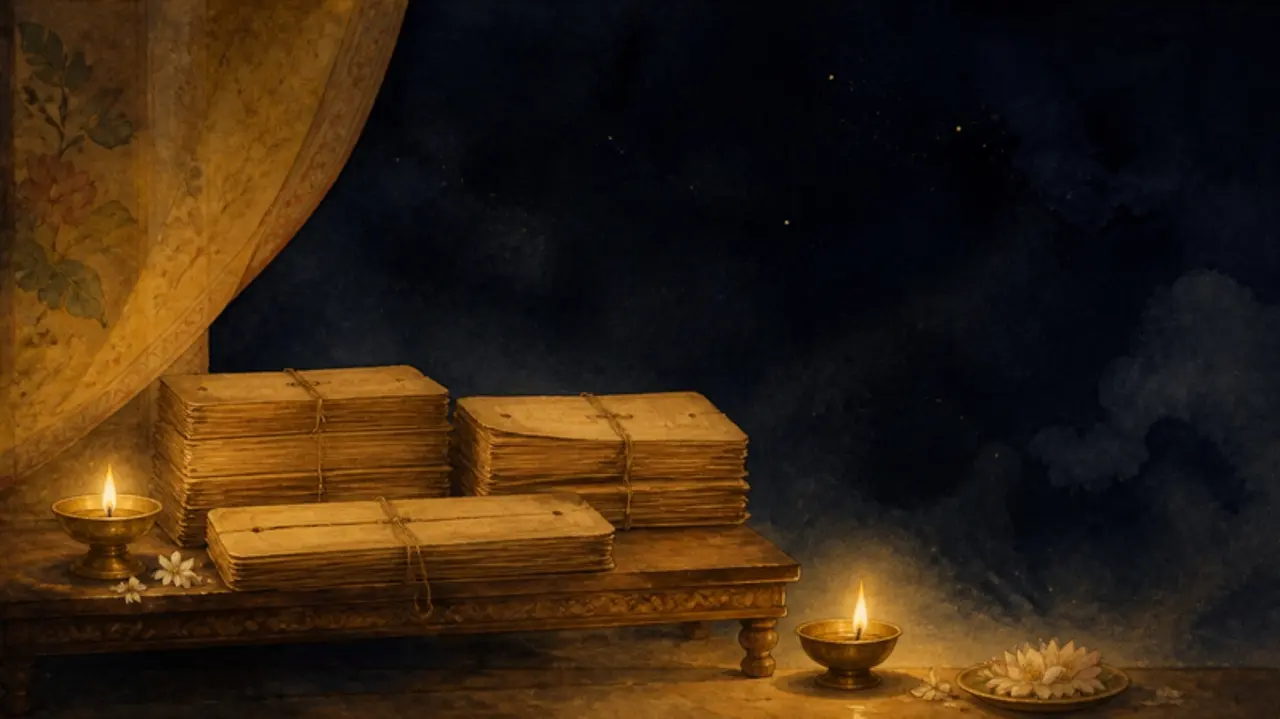
Palm-leaf manuscripts on a wooden shelf, lit by small oil lamps
Also calledIshavasya Upanishad (ईशावास्योपनिषद्), named after its first words
Comes fromThe last chapter (chapter 40) of the Shukla Yajurveda Samhita. It is the only major Upanishad that sits inside a Veda's core hymn collection
Place in the traditionFirst in the Muktika list of 108 Upanishads, and one of the principal Upanishads that Adi Shankaracharya wrote a commentary on
Size18 verses (the Kanva version, used here)
Best forAnyone asking how to live a spiritual life without running away from work, money or family

Sources

You reached the end

॥ इति ॥ Thank you for reading.

If it helped you, pass it on to one person who would like it.

Spotted a mistake, or have a suggestion?