Goddess scriptures · Itihāsa · Book 2 of the Tatvamaya Library
Tripura Rahasya
त्रिपुरारहस्यम्
There is one Consciousness, and the whole world is its reflection.
22
chapters
5
parts
95
minutes to read
In one minute
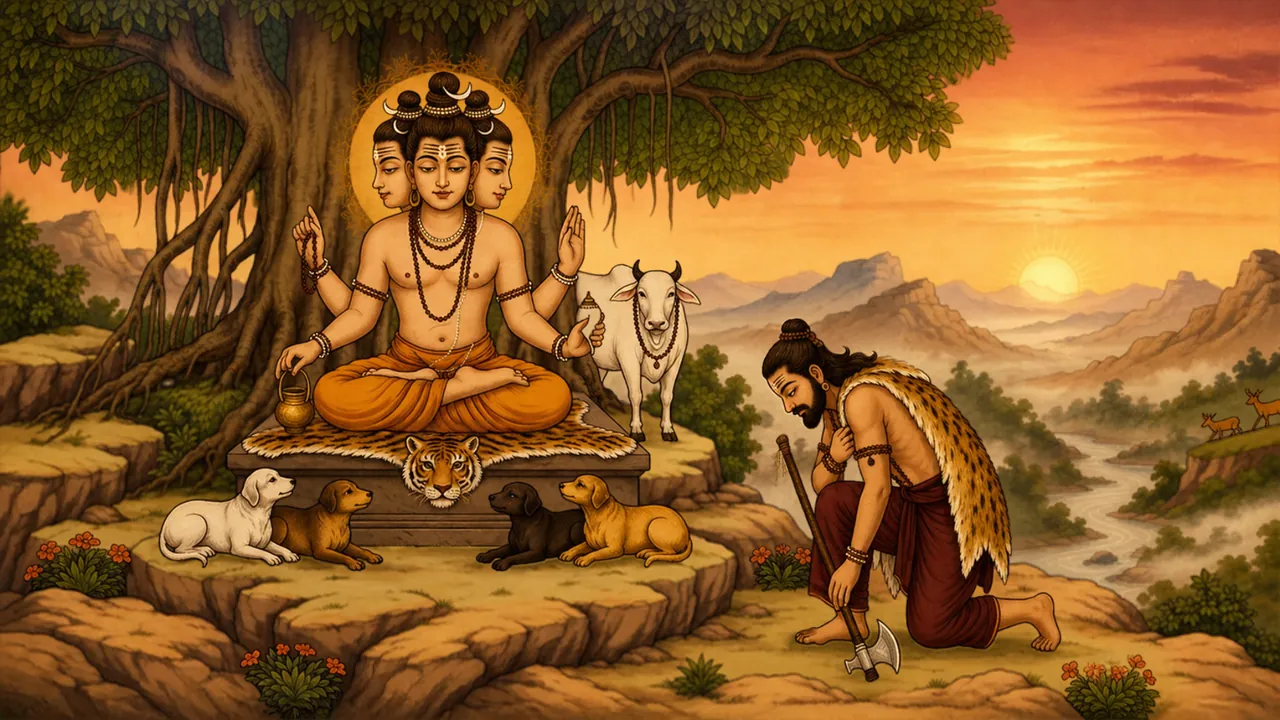
A warrior-sage named Paraśurāma has done everything life asked of him: fought, worshipped, served. Yet one quiet question will not leave him alone: what is all this for? He goes back to his teacher, Dattātreya, and this book is what Dattātreya tells him.
Dattātreya does not lecture. He tells stories. A young prince, Hemacūḍa, marries a wise girl, Hemalekhā, who keeps asking him simple questions about happiness until his whole world turns inside out. A king follows a sage's son into a hill and finds an entire universe inside it. King Janaka hosts a debate where a proud young scholar learns that knowing about truth is not the same as knowing truth. And finally Dattātreya speaks plainly about what reality is.
The answer running through every story is one bold idea: there is only one Consciousness, and the whole world appears in it the way pictures appear in a mirror. The text calls that Consciousness Tripurā, the Divine Mother. You do not have to travel anywhere to find Her. She is the awareness reading these words.
Three big ideas
The world is a reflection in Consciousness. Everything you see, think and feel appears in awareness, like images in a mirror. The images change; the mirror does not.
Questions are the beginning of freedom. Every awakening in this book starts with someone honestly asking, "Is this really happiness?" Good company and sincere inquiry do the rest.
Freedom is lived, not escaped into. Hemacūḍa and Janaka stay kings. Wisdom does not take them out of life; it changes how they live it.
Before we begin
Who's who
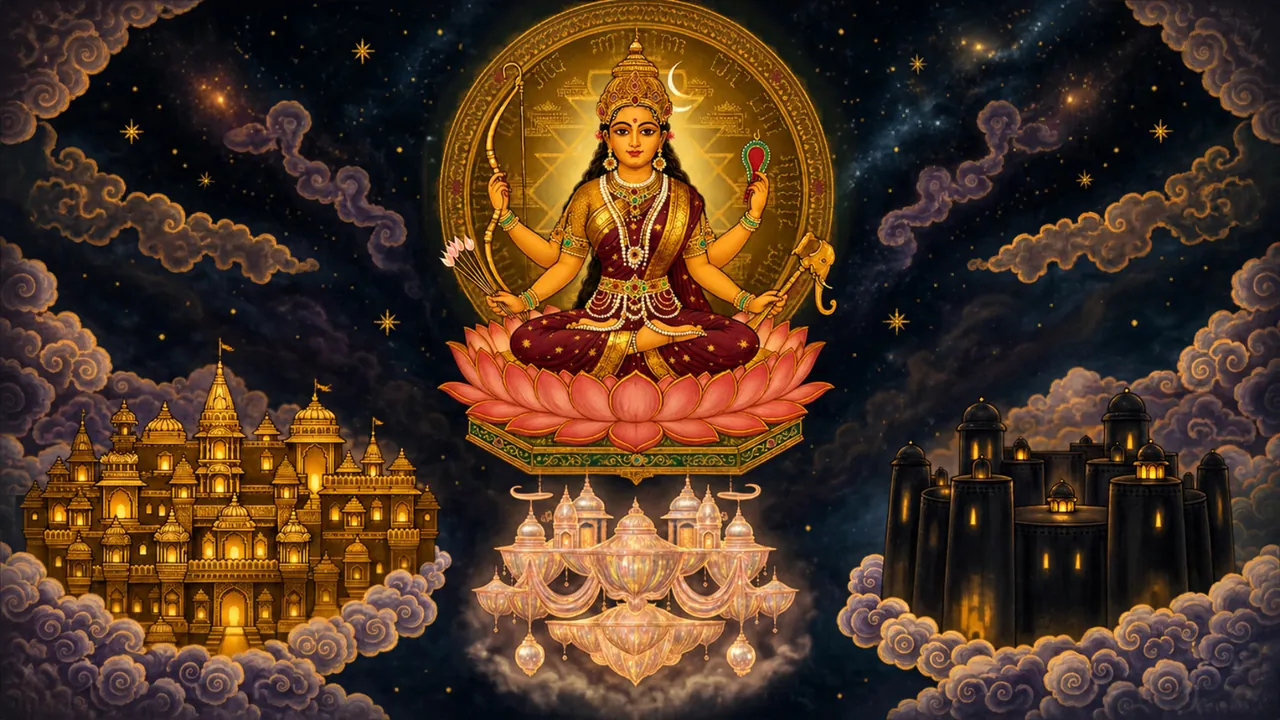
The book opens with a salutation to the Goddess as Consciousness itself, the mirror in which the whole world appears.
MeaningSalutations. She, the Supreme Consciousness whose nature is the joy at the root of everything, shines as the mirror in which the whole wonderful picture of the world appears.
What it is sayingBefore a single story begins, the book tells us where it is heading. The world is like a picture, and Consciousness is like a mirror. A mirror can show mountains, faces and fire without becoming any of them. That is the idea the next 22 chapters unfold.
The people in this book.
Tripurā is the Divine Mother, worshipped in the Shakta tradition and in Śrī Vidyā. In this book She is not a distant goddess but pure Consciousness, the awareness behind everything. Her name is often explained as "She who is before the three": before the three states of waking, dreaming and deep sleep, and before the three qualities of nature.
Dattātreya is the great teacher, honoured as a divine guru and as the master of the avadhūtas, sages free of every convention. He is the main teacher in this book.
Paraśurāma is the warrior-sage, son of the sage Jamadagni. He is Dattātreya's student, and his questions drive the whole book.
Haritāyana is the sage who received this teaching from Paraśurāma and put it into words. The book is named after him too: the Haritāyana Saṁhitā.
Nārada is the wandering divine sage. Haritāyana tells the whole story to him.
How it is told. The teaching travels like a story inside a story: Dattātreya tells it to Paraśurāma, Haritāyana tells it to Nārada, and inside Dattātreya's stories the characters tell stories of their own. Each chapter on this path keeps track of who is speaking.
Why it starts hereRamana Maharshi counted the Tripura Rahasya among the greatest books on non-duality (Advaita) and often quoted it to visitors. His comments on several chapters are included, briefly, where he gave them.
Word by word
Word by word
oṁ namaḥ
Om, salutations
kāraṇa-ānanda-rūpiṇī
whose form is the bliss at the root of all
parā
supreme
cinmayī
made of Consciousness
virājate
shines
jagat
the world
citra
wonderful
citra
picture
darpaṇa-rūpiṇī
as the mirror
Part 1 · Chapters 1–2
The warrior's question
Chapter 1: A disciple returns with questions
कर्तव्यतैव दुःखानां परमं दुःखमुच्यते।तत्सत्त्वे तु कथं ते स्तो दुःखाभावः सुखं च वा॥
kartavyataiva duḥkhānāṁ paramaṁ duḥkhamucyate / tatsattve tu kathaṁ te sto duḥkhābhāvaḥ sukhaṁ ca vā
MeaningAs long as you feel you have to keep doing something in order to be happy, you are not happy yet. That feeling of "I must" is the deepest kind of suffering.
The story. The book opens with a bow to Om: the one consciousness in which this whole wonderful universe appears, the way pictures appear in a mirror. Then we meet the storyteller. The sage Hāritāyana is speaking to the sage Nārada. Narada has already heard the first part of this work, the Glory (Māhātmya) of Śrī Tripurā. Now Haritayana offers wisdom itself, a teaching that ends sorrow for good once it is truly heard: the essence of the Vedic, Vaishnava, Shaiva, Shakta and Pashupata traditions, first taught by the master Dattātreya to his disciple Paraśurāma from his own experience. In the bold style of old texts, he adds that whoever hears it and still misses the truth is beyond even Shiva's help. That is praise for the teaching, not a curse on the reader.
Inside this frame, the real story begins. Parashurama has been listening to his Guru, Dattatreya (often just "Datta"), tell the glory of the Goddess Tripurā. He is so moved that he goes still, his eyes shine, the hair on his body stands up, and he falls at his teacher's feet. When he rises, his voice breaks. His Guru, he says, is Shiva's own grace walking in human form: "The Guru's grace gained, I have gained all." He asks how to worship the Goddess. Datta makes sure he is ready, then initiates him into the chants, the sacred diagrams (yantras) and the meditations. Parashurama collects every detail like a bee collecting honey, walks around his teacher in respect, and leaves for Mahendra Hill.
There he builds a simple hermitage and worships Tripurā for twelve years, alongside his daily duties. The years pass in a flash. Then one day, sitting at ease, he falls into thought. Long ago he had met the sage Saṁvarta on the road and asked him about creation. He had understood almost nothing of the answer. Samvarta had mentioned the story of Kalakrit and then stopped, seeing that Parashurama was not ready.
His thoughts widen. Where does this universe rise from, and where does it end? He was one person as a child, another as a young man, and someone else again now. People reach one goal and at once start chasing the next. A beggar works as hard for happiness as an emperor, and each feels blessed when he gets what he wanted, until the next want arrives. Parashurama sees that he too has been copying everyone else, a blind man following the blind. He decides that this foolishness has gone on long enough, walks down the hill, and finds Datta on Gandhamādana mountain, seated in lotus posture. He touches his Guru's feet to his head. Datta, glowing with love, tells his child to get up and asks after his health. Parashurama replies that no illness can touch someone soaked in his Guru's kindness. He has only a few doubts he has carried for a long time. Datta, pleased with his devotion, tells him to ask.
What it is teaching. The twelve years of worship were not a failure. They cleaned Parashurama's mind enough for real questions to come up. His restlessness is a good sign: devotion has done its work, and now it is turning into inquiry.
Why does reaching a goal never end the chase? Parashurama's answer is sharp: the pleasures we get while we are still driven are like soothing cream on a burn, or a sweet scent breathed in during a bad stomach ache. Pleasant for a moment, but the pain underneath is still there. Only people who no longer need to do anything in order to be happy are truly at ease, content and complete in themselves. And the right response to this discovery is not despair. It is to go back to the teacher.
A modern way to see itThink of the exam treadmill. In Class 10 you are told that everything will be fine once you clear the boards. Then it is JEE or NEET. Then placements. Then the promotion, the flat, the car. Each finish line feels great for about a week, and then a new "must" appears. Nothing is wrong with any of these goals. Parashurama's point is about the feeling underneath: as long as happiness always lives at the next finish line, you never actually get to live there.
RememberEvery "I'll be happy when..." is a small admission that you are not happy now. Notice it, and start asking why.
The book does not tell us what Samvarta said or what the story of Kalakrit is; those stay open. The chapter's real gift is the order of the spiritual life it shows: first devotion, which purifies; then honest dissatisfaction, which asks; then the teacher, who answers. In the Shakta tradition, the Goddess is both the one worshipped and the one who wakes the worshipper up.
Word by word
Word by word
kartavyatā
the feeling "I still have to do"
eva
itself
duḥkhānām
of all sorrows
paramam duḥkham
the greatest sorrow
ucyate
is called
tat-sattve
while it remains
tu
but
katham
how
te staḥ
can these two be
duḥkha-abhāvaḥ
freedom from sorrow
sukham
happiness
ca vā
or
Deeper meaning
Deeper meaningThe opening image, consciousness as a mirror in which the universe appears, comes back again and again in this book: in the parrots' song in chapter 4, in the description of the Goddess in chapter 7, and in Ramana Maharshi's comments. It is worth holding on to. The name Tripurā itself is explained by the text in chapter 7: she is pure consciousness, called Tripurā because she is beyond the three states of waking, dreaming and deep sleep.
Chapter 2: The poison of "I must"
राधिता परमा देवी सम्यक् तुष्टा सती तदा।विचाररूपतां याति चित्ताकाशे रविर्यथा॥
MeaningThe power to question deeply is not something we produce on our own. It is the Goddess's grace, ripened by devotion, appearing in us as clear inquiry.
The story. Parashurama begins with a confession. Long ago, for a reason he felt was just, he turned his fury on the kingly class (the kshatriyas) and made war on them across the land twenty-one times, sparing no one. His ancestors were pleased with his loyalty to them, but they ordered him to stop, and his rage cooled. Then he heard of Rama of Ayodhya, Vishnu come to earth, and the anger flared up again. Proud of his strength, he challenged him and was defeated. Rama, out of kindness, let him go with his life; Parashurama says this was because he was a Brahmin. (In this book Datta often calls Parashurama himself "Rama"; Rama of Ayodhya is a different person.)
Walking home humbled, he saw how empty the world's ways are. On the road he met Samvarta, the greatest of the avadhūtas, the free wandering sages who ignore every social rule. His greatness was hidden like a live coal under ash, yet just being near him felt refreshing. Parashurama asked about his state. The answer was clear, but Parashurama felt like a beggar girl standing before a queen and could not follow it. Samvarta sent him to Datta.
Now he lays out his doubts. He has pleased the gods, Indra included, with rituals and offerings, but their results are small. Misery, he says, is not the absence of happiness but happiness with a limit on it, and behind every action lies the fear of death, which no amount of activity removes. Even his devotional practices feel like child's play: every teacher and every book prescribes them differently, and they never end. Yet Samvarta is free of every sense of duty and perfectly happy, like an elephant cooling itself in a snow-fed lake while the forest around it burns. How did he get there? Parashurama falls at Datta's feet.
Datta sees that his disciple is ready. Your past good deeds, he says, have brought you here like a boat reaching a drowning man. Tripura, the conscious heart of every being, rescues those who hold on to her. Then he describes the sense of obligation as a nightmare and a snakebite. Some people go mad from its poison; others are numbed and can no longer tell good from bad. He tells of hungry travellers in the Vindhya forest who ate poisonous fruit, thinking it was oranges. Sick and confused, they ate thorn-apples for relief, thinking they were rose-apples. Now mad, they fell into pits, tore themselves on thorns and fought one another. Reaching a town at nightfall, they attacked the guards and were beaten back; some drowned, some were taken by crocodiles, some ended in prison. So it goes, Datta says, for everyone who chases happiness through endless action.
What saves a person is vichāra: inquiry, careful thought. It is the root of every good and the first step to bliss; the lack of it is certain ruin. The gods win because they deliberate. Even the greatest stumble when they do not: Rama of Ayodhya ran after the golden deer without thinking and met disaster, then thought things through and bridged the ocean to Lanka; Brahma acted rashly and lost one of his five heads; Shiva granted a boon to a demon without thinking and had to run for his life. But inquiry cannot spring up by itself in minds soaked in ignorance since time without beginning, any more than dew can gather in a scorching desert. It comes by the Goddess's grace. The path runs like this: hearing her glory leads to devotion and earnestness, these lead to sincere worship exactly as the Guru teaches, and worship ripens into inquiry. Datta admits he was anxious about Parashurama, the way one worries over a delirious patient until the fever turns. A person without inquiry, he says, is like a frog in a well, or a donkey who keeps following the one who kicks him. But Parashurama, by inquiring, has already gone beyond misery.
What it is teaching. The trouble is not action itself. It is the compulsive feeling that we must act in order to be happy, a feeling that drives some people frantic and leaves others dull and confused. Each "remedy" we reach for, like the travellers' second fruit, often makes the poisoning worse.
The cure is inquiry: stopping to look clearly at what we are doing and why. As Datta puts it, "The only useful fruit of life is Vichara." And this chapter is careful about where inquiry comes from. It does not reject devotion. It says devotion, done sincerely, is exactly what turns into clear seeing.
A modern way to see itIt is midnight and you feel anxious about tomorrow's presentation. To calm down you open Instagram. Forty minutes of reels later you feel worse, so you order something sweet, then feel guilty, then lie awake scrolling through work messages because you "should" reply. Each fix was another poisonous fruit. The way out was never a better app. It was the moment you put the phone down and asked, honestly, "What am I actually running from?" That question is vichara.
RememberThe "must" that drives you can also blind you. Stop, look, and ask why.
Parashurama's own arc is also part of the teaching. His story moves from rage, to defeat and humbling, to meeting a free sage, to sincere worship, and only then to real questions. The book does not praise his violence. It shows a proud warrior being slowly turned inward, until the fiercest man in the room becomes a student.
Word by word
Word by word
rādhitā
worshipped
paramā devī
the supreme Goddess
samyak
fully
tuṣṭā satī
being pleased
tadā
then
vicāra-rūpatām
the form of inquiry
yāti
takes on
citta-ākāśe
in the sky of the mind
raviḥ yathā
like the sun
Deeper meaning
Deeper meaningThis chapter is the bridge between devotion (bhakti) and knowledge (jñāna). Parashurama calls his practices child's play, but that is the seeker's frustration speaking, not the final word. Datta's answer is that those very practices, offered sincerely, are what made the question possible. The translator adds a homely picture for this: the Goddess is present all along, the way butterfat is present in milk, in curd and in butter, at every stage.
Part 2 · Chapters 3–11
Prince Hemacūḍa and the wise Hemalekhā
Chapter 3: A storm, a hermitage, a wise bride
शृणु राम प्रवक्ष्यामि निदानं श्रेयसः परम्।सद्भिः सङ्गः परं मूलं सर्वदुःखनिबर्हणम्॥
MeaningThe surest way out of sorrow is to spend time with people who have already found their way out. Good company is where every good thing begins.
The story. Parashurama has a follow-up question. If inquiry is the key, where does inquiry come from? If it were natural, everyone would have it. Why has it come to him and not to people who suffer far more? Datta answers: the root cause is satsaṅga, the company of the wise. Your meeting with Samvarta, he says, is what brought you this far. When people approach sages, sages teach them the highest good, and a person always reaps the fruit of the company they keep. Then he tells a story.
King Muktacūḍa of Daśārṇa had two fine, well-mannered, learned sons, Hemacūḍa and Maṇicūḍa. One day the princes led a large hunting party into the Sahya mountains and brought down many animals. Suddenly a storm broke, hurling sand and pebbles. The sky went dark as night; no rock, tree or man could be seen. The hunters scattered for shelter, and the two princes galloped off on horseback.
Hemachuda came at last to a sage's hermitage set in a garden of plantain and date palms. There he saw a young woman who seemed to shine like gold, as lovely as the Goddess of Fortune. Dazzled, he asked who she was and why she lived alone in so wild a forest. She welcomed him calmly, told him to tie his horse to a date palm and rest, and brought him fruit and juice. Then she told her story. Her name was Hemalekhā, and she was the foster daughter of the sage Vyāghrapāda, a great devotee of Shiva honoured by saints everywhere. Her birth mother was Vidyutprabhā, a celestial woman (Vidyādharī), who had come to bathe in the river Venā. King Suṣeṇa of Vaṅga saw her, they fell in love, and he went home leaving her with child. Afraid of scandal, her mother did not want the child, yet the baby was born alive. Vyaghrapada found her on the riverbank when he came for his evening prayers and raised her with a mother's tenderness. A true father, she said, is the one who lovingly protects. No god or demon with bad intent could enter this hermitage. The prince should wait and meet her father.
Hemachuda had fallen in love, but he said nothing for fear of offending her. She saw it anyway and told him to be steady and tell her father everything. Vyaghrapada arrived with a basket of flowers for worship. The prince bowed and gave his name. The sage, who could see the whole situation with his inner sight, thought it over and gave Hemalekha to him in marriage. The prince brought her home, his father ordered celebrations, and the couple enjoyed happy days in the palace, in forest retreats and on sandy beaches.
But something puzzled the prince. Hemalekha did not seem as caught up in pleasure as he was. Her mind often seemed elsewhere; she sat with her eyes closed; once, after he had held her for a long while, she looked up and asked, "Lord, when did you come?" He told her she was like a beautiful painting, lovely but unmoved. He was always turned towards her, he said, like the night lily that opens to the moon. Why was she like this? He begged her to tell him.
What it is teaching. Inquiry does not arrive at random. It is passed on, the way a flame passes from one lamp to another. Its root is satsanga: being near people who see clearly. Parashurama met Samvarta; Hemachuda is about to meet his own teacher in the most unexpected place, his own home.
There is a quieter lesson too. Hemalekha says that the one who protects and cares is the real parent. Love is shown in what people do, not only in birth.
A modern way to see itA college student joins a weekend running group just to fill her Sundays. She cannot run two kilometres. But the group talks about pacing, sleep and food, and nobody makes excuses. A year later she finishes her first half marathon. She never decided to become a runner; she decided who to spend Sundays with, and the rest followed. That is satsanga in miniature.
RememberYou become like the people you sit with. Choose them carefully, and sit close to the wise.
The pattern of this whole section is already visible: the seeker comes, restless and attached; the wise one does not lecture, but waits for the right question. Hemachuda has just asked it.
Word by word
Word by word
śṛṇu
listen
rāma
Rāma (Paraśurāma)
pravakṣyāmi
I will tell you
nidānam param
the first cause
śreyasaḥ
of the highest good
sadbhiḥ saṅgaḥ
company with the wise
param mūlam
is the deepest root
sarva-duḥkha-nibarhaṇam
of the ending of all sorrow
Deeper meaning
Deeper meaningNotice how the story sets up its teacher. Hemalekha is the one who stays calm in the storm, who offers food and rest, who sees the prince's feelings before he speaks. Her "absent-mindedness" in the palace is not coldness. It is the state of someone resting in the Self even in the middle of pleasures, and the next chapter will show it.
MeaningThe sorrow of the mind is far greater than pain of the body, and it holds the whole world in its grip. Its seed is desire, a seed with tremendous power to grow.
The story. Hemalekha smiles and answers gently. She does love him, she says. It is only that she is searching for the greatest joy in life, one that will never grow stale, and she has not found it yet. Would he teach her? The prince laughs and brushes her off with a sneer about women's judgement. Even birds and insects know, he says: pleasant is good, unpleasant is bad. What is there to think about? This is the prince before his awakening speaking, and the story turns his remark upside down: the young woman he mocks will teach him and his whole kingdom.
With gentle irony, Hemalekha agrees to be taught, and then takes his idea apart. The same thing gives pleasure or pain depending on circumstances. Fire is welcome in winter and unbearable in summer. The same is true of wealth, children, a kingdom. Look at your father, the king: he has everything, yet he is worried every day. "That cannot be happiness, my Lord, which is tinged with misery." Pain is of two kinds, bodily and mental, and the mental kind, born of desire, is far worse. Even Indra and the gods serve desire day and night. The short pause between one desire being met and the next arriving is not happiness; insects have that too. The pleasures of the senses, even the closest ones, end in tiredness and are shared with every animal. And the delight of beauty? That comes from the mind, as dreams prove.
She tells a story. A handsome prince adored his wife and thought himself the happiest of husbands. But she loved a servant, and the servant kept the prince drunk every night and sent another woman to his room. In his stupor the prince never knew. One night the servant was busy, the prince drank less, and he realised the woman beside him was not his wife. He demanded the truth and was led to his wife with the servant. Shocked, he condemned his own drinking and his infatuation, and left for the forest. His happiness, Hemalekha points out, had been entirely in his own head.
Beauty, then, is a picture the mind draws and redraws until it seems solid "out there". Children and self-controlled yogis are not stirred by it. Every husband finds his own wife lovely; every land has different ideas of beauty, yet everyone feels the same pleasure. Men look for delight in women's bodies and women in men's, but look closely, she says, at what any body is made of: flesh, blood, bone, bile, waste. Pointing to herself, she asks him to examine her own body the same way. Where, then, is the pleasure really coming from?
Hemachuda is stunned. He turns away from worldly pleasures, thinks over all she has said, and talks with her again and again. Here Datta's telling runs ahead to the end of the story. The prince, he says, came to see that pure consciousness, his own Self, is Tripura herself, the One holding all, and he was liberated while still alive. He guided his brother and father to the same freedom; Hemalekha guided the queen; ministers and citizens followed. The city of Viśālā became so wise that even the caged parrots sang: meditate on the Self, pure consciousness, which shines like a self-luminous mirror holding all things within it. The sage Vāmadeva and others heard the parrots and named it the City of Wisdom. All this, Datta tells Parashurama, came from one wise woman's company. The next four chapters go back and show how it actually happened, step by step.
What it is teaching. Hemalekha takes apart the most common idea of happiness: "good is whatever feels good." Feelings depend on season, place and person, so they cannot be the measure. Real happiness cannot have sorrow hidden inside it, and anything that depends on desire does.
Her second point is subtler. Beauty and pleasure are not sitting in objects waiting to be picked up. The mind builds them by repeated imagining, and then falls under the spell of its own picture. A settled mind sees the same things and is not pulled.
A modern way to see itThere is a song you loved all through a relationship. After the breakup, the first two notes make you switch it off. The song has not changed by a single beat. What changed was the picture in your mind that the song was attached to. Hemalekha would say: notice that. The sweetness and the sting were both coming from inside you.
RememberIf your joy depends on the next desire, it was never joy. Look for the happiness that does not need anything.
What Ramana Maharshi said. Ramana Maharshi took the parrots' song as the heart of this chapter: turn from sense pleasures, which end in misery, and contemplate the Self, which is consciousness itself. "Worship" here, he explained, means staying firmly in the knowing "I am Brahman", not outer ritual, and it does not mean harming the body. Objects shine only because consciousness lights them, the way images appear in a clear mirror; the mirror is untouched by what it shows. That is why he called this the doctrine of reflection.
Two cautions help here. First, the body contemplation is not an attack on the body, and not an attack on women: Hemalekha applies it to men's bodies and to her own. It is an old method for loosening compulsive craving. Second, the chapter's happy ending is a flash-forward. Liberation came, the text says, through talking things over again and again, and the next chapters show that slow and very human process.
Word by word
Word by word
mahattaram
far greater
mānasam
(is the sorrow) of the mind
syāt
is
yena
by which
grastam
gripped
idam jagat
this whole world
vāñchā eva
desire alone
duḥkha-viṭapi
of the tree of sorrow
bījam
is the seed
sudṛḍha-śaktikam
with great power to grow
Deeper meaning
Deeper meaningThe parrots' song gives the whole philosophy of the book in a few lines. Consciousness is the subject and also all the objects; everything shines by its light, and it shines by itself. Ramana read this carefully: the world is not something that grows out of consciousness like a sprout from a seed, nor something it turns into like clay into pots, nor a mistake laid over it like a snake seen in a rope. It is consciousness showing images within itself by its own power, as a mirror does.
MeaningHe tried every way to overpower her, yet she, pure by her very nature, never truly came under his power. In the same way the true Self only seems caught up in the mind's adventures. It stays pure and untouched.
The story. Parashurama asks to hear more: how did Hemalekha guide the prince further? He adds that everyone reached the highest good through her, "though she was only a woman". The story he is about to hear answers that remark better than any argument. Datta goes back to the time right after Hemalekha's first talk. Hemachuda had lost his taste for pleasures, but the force of habit had not let go. He could neither enjoy them nor give them up, and he was too proud to tell his wife. He kept sliding back into old ways, then feeling ashamed, swinging to and fro. Food, fine clothes, jewels, horses, even friends gave him nothing. He grew pale and sad.
Hemalekha came to him in private. Lightly, she spoke of how doctors trace illness to imbalances of the body's three humours, and added that medicine does not treat invisible diseases. What was wrong? He told her: her words had spoiled every pleasure for him. He felt like a prisoner condemned to death who is offered luxuries, and like a man forced by a royal order to act against his will. How could he be happy? Hemalekha thought to herself that this dispassion was the seed of the highest good, a sign that the Goddess within his heart was pleased with him. Keeping her own wisdom hidden, she offered to tell him the story of her own past.
Her mother, she said, gave her a companion, good by nature. This friend fell in with a clever, scheming woman who kept producing new and dazzling things, and Hemalekha, who could not bear to be apart from her friend, was drawn in too. The schemer secretly introduced her son, Mr Fool, a dull man with drink-reddened eyes, and the friend became his partner, though she never left Hemalekha. Their son was Master Inconstant: restless, dull like his father, crafty and inventive like his grandmother, Madame Ignorance. He could cross any obstacle in a blink. Slowly the friend drifted from Hemalekha, but Hemalekha could not leave her. Mr Fool tried to take hold of Hemalekha too, mistaking her for one of them. But she was not what he took her to be. She is pure by nature. Still, people gossiped that she was in his power.
Hemalekha raised Master Inconstant. He married Madam Unsteady, who could change her form to suit his every whim and so ruled him completely. He flew hundreds of miles in a moment and came back, yet never found rest. They had five sons, also raised by Hemalekha, and each son built a mansion and entertained his father in turn. The first offered every kind of sound, from music and chanting to thunder and wailing; the second, every kind of touch, soft beds and hot and cold things; the third, every colour and shape, lovely or ugly; the fourth, every taste; the fifth, every scent, sweet or foul. Inconstant liked some and hated others, and he secretly carried things off from his sons' houses to share with his wife at home.
Then he took a second wife, Madam Vorax, whose hunger could never be filled; she kept him and all five sons running for her food. She bore two sons, Master Flaming-mouth and Master Mean. When Inconstant went to Vorax, Flaming-mouth burned him until he fainted; when he petted Mean, the whole world despised him. His mother, the friend, suffered with him, and Hemalekha suffered beside her. At last they all moved into a city of ten gates, seeking pleasure and finding only misery. Hemalekha stayed out of love, and without her, she says, none of them could have lived in that city at all; she was their protector. She seemed to take on every mood around her, so common people misjudged her, but the discerning could see she had always stayed pure.
Her mother, she said, is purer than anything, vaster than space and subtler than the subtlest. She knows all yet seems limited, does everything yet stays still, holds up all yet rests on nothing, has every form yet no form, lights up everything yet is never seen as an object, is bliss itself. She has no parents, and daughters like Hemalekha as countless as the waves of the sea. Hemalekha holds a powerful spell that keeps her exactly like her mother. When Inconstant falls asleep in his mother's lap, everyone sleeps, and his friend Mr Motion guards the city, passing in and out through two upper gates. In that pause Hemalekha slips away to her mother and rests in her embrace, until the sleepers wake. Mr Motion holds the whole household together like the string of a necklace, drawing his strength from Hemalekha, and when one city crumbles he leads them all to another. Yet for all this help, Inconstant is always miserable, dragged by his wives and sons through forests, deserts, icy wastes and dark holes. Who can find happiness in bad company? It is like drinking water from a mirage.
Then the ending. Once, deep in grief, the friend came to Hemalekha in private. On her advice the friend found a good husband, brought her son's rule to an end, and locked his sons away. Then, with Hemalekha, she reached the mother, embraced her, dived into the sea of bliss and became bliss itself. You too, Hemalekha tells the prince, can overcome your wrong ways, because they are only layers that have gathered on you, not your nature. Reach the Mother and be happy for ever.
What it is teaching. Losing interest in pleasures is a real step, but habit does not let go overnight. The swinging back and forth that Hemachuda feels is normal, and Hemalekha reads it as a good sign: the seed of freedom has sprouted.
Her riddle is a map of the inner life, and she will give the key in chapter 8. Even before that, its main point is clear. Something in us lives through all the mind's restlessness, the senses' entertainments and desire's endless hunger, and keeps them all alive, yet is never stained by them. And the knots we struggle with are only accretions, so they can come off.
A modern way to see itYou open your phone to answer one message. Your eyes catch a reel, your ears catch a song, and an hour disappears. A comment makes you angry; a sale makes you want. That night you dream of the same feed. All evening the mind ran from house to house like Master Inconstant. Yet something was quietly aware of every bit of it, and it was not tired, angry or hungry. In deep sleep, when the phone and the mind both go quiet, you still wake up saying, "I slept well." Who was there, resting?
RememberYour restlessness is a family you live with, not who you are. What you truly are was never stained.
What Ramana Maharshi said. Ramana Maharshi retold this parable with its meaning built in. The friend is the intellect, the narrator is the individual consciousness, and the intellect's child by delusion is the mind. He read the "good husband" as discrimination (viveka), gained when the intellect turns to the Self in secret, in a moment free of thoughts; with its help it subdues the mind, overcomes anger and greed, restrains the senses, and unites with the Self in nirvikalpa samādhi. His conclusion: bondage and liberation belong only to the intellect, never to the Self.
The sleep passage matters too. Every night, when the mind rests, the narrator returns to her source and rests in bliss, then has to come back when the household wakes. That is why deep sleep feels so good, and why it is not yet freedom: the return is involuntary and temporary. The friend's final journey is the same return made awake and for good.
Word by word
Word by word
prasahya
by force
mām
me
samākrāntum
to overpower
udyuktaḥ abhavat
he set out
sarvathā
in every way
na aham
I did not
svabhāva-saṁśuddhā
pure by my very nature
vastutaḥ
in truth
tad-vaśam gatā
come under his power
Deeper meaning
Deeper meaningThe most striking line is the description of the Mother, built entirely of opposites. It is not a puzzle to be solved but a way of pointing past every category the mind uses. Ramana gave one of these a helpful image: she has all shapes and no shape, like a mirror that shows every form and has none of its own.
MeaningFaith is a mother. Like a loving mother with her child, she always protects whoever turns to her, even from the greatest fears.
The story. Hemachuda, still not ready, laughs at the riddle. It is pure invention, he says, rambling, like the talk of someone not in her right mind. She is young, yet she talks as if she were generations old. Where is this friend, this son who was killed, these cities? There is no such lady in the palace; she can ask his mother. Her story, he says, is like a clown's tale of a barren woman's son who rode a chariot seen in a mirror, fought battles in the sky and amused himself with dream maidens beside a mirage lake. Impossible from start to finish.
Hemalekha answers calmly. People like her do not speak nonsense: a lie would destroy the fruit of her own spiritual discipline, and anyone who feeds an earnest seeker with empty words ruins himself. A half-blind man is not cured by hearing the prescription read aloud. Then she offers him evidence from his own life. Things that once pleased him stopped pleasing him after she spoke. Her words produced that change, and they will do more. Is that the effect of a fairy tale?
Then she speaks of faith (śraddhā). Distrust of a well-wisher is the shortest road to ruin. All of life runs on trust: the baby trusts its mother, the lover the beloved, the old parent the grown child, and the farmer who ploughs trusts there will be a harvest. Even our belief that a cause will bring its effect is a kind of faith. Without any trust at all, a person would be too afraid even to breathe. Hemachuda objects: surely one should trust only those who are worthy, or one ends up like a fish on a hook. Hemalekha asks: how will you judge worth? By some standard. And who checks the standard? And the one who checks it? The questions never end. "Therefore life moves by faith only." Endless debate and simple acceptance both fall short, she says, but there is some hope for simple acceptance and none for endless debate.
She tells a story. The sage Kauśika lived on the Sahya hills near the river Godāvarī, serene and wise, with many disciples. One day while he was away, the disciples began debating, and a brilliant scholar named Soonga arrived. He had great learning but no faith and no conviction. Whatever standard of truth they offered, he asked for a standard to test it, and another to test that, until nothing was left. Nothing can be known, he concluded; all is void. And even that statement, he added, is void. Some disciples were swept away by his cleverness, became teachers of the void, and lost themselves in it. The wiser ones took his arguments to their master, were shown the truth, and found peace. So, Hemalekha says, beware of dry argument dressed up as logic. Use reason the way the scriptures do, in the service of truth.
Hemachuda is amazed. He had not seen her wisdom before, he says; she is blessed, and so is he for having her. Now he asks better questions. How exactly does faith lead to the highest good? Scriptures, teachers and commentaries all disagree, and each calls the others wrong. Reasoning alone is no guide. And why shouldn't the school of the void be respected, since it has its followers and its system too? Explain all this, he says.
What it is teaching. This chapter is not against thinking. Hemalekha argues brilliantly the whole way through. What she rejects is argument that has no aim and no trust behind it, the kind that keeps demanding proof of the proof until it saws off the branch it is sitting on.
Her positive point is that every real step in life begins with some trust. We test a teaching by its effects in our own experience, as the prince already has, and then we must act on it. A mind that trusts nothing cannot learn anything.
A modern way to see itTwo friends want to learn to code. One spends three months comparing laptops, reading every Reddit thread on which language is best, and watching videos about which course to choose. Every recommendation has a counter-argument, so he never starts. The other asks a senior she trusts, takes the advice, and starts that evening. Six months later she has built an app. Her first step was not blind; it was trust in someone who had walked the road, tested against her own progress. That is the faith Hemalekha means.
RememberEndless doubt feels clever but goes nowhere. Trust someone wise enough to start, then test the teaching by living it.
Notice also how the prince changes in this chapter. He starts by mocking and ends by asking. That shift, from defending what he already thinks to genuinely wanting to know, is what faith looks like in practice. The next chapter will answer his questions with a full picture: discussion, then effort, then devotion to God.
Word by word
Word by word
śraddhā
faith
mātā
is a mother
prapannam
whoever turns to her
sā
she
vatsalā iva
like a loving (mother)
sutam
her child
sadā
always
rakṣati
protects
prauḍha-bhītibhyaḥ
from the greatest fears
sarvathā
in every way
nahi saṁśayaḥ
there is no doubt
Deeper meaning
Deeper meaningSoonga's argument is an old and serious one: if every standard needs another standard, nothing can ever be proved. Hemalekha does not deny the problem. She shows that the same doubt, turned on itself, destroys itself, which is exactly what happens to Soonga's claim that all is void. The text does not tie this to any historical school; it simply shows where faithless logic ends up.
Chapter 7: Who is God, and how to reach Her
ईश्वरो हि जगज्जालप्रलयोत्पादकृद् भवेत्।स विष्णुः स शिवो धाता स सूर्यः सोम एव च॥
īśvaro hi jagajjālapralayotpādakṛd bhavet / sa viṣṇuḥ sa śivo dhātā sa sūryaḥ soma eva ca
MeaningGod is the one who brings the whole web of the world into being and dissolves it again. He is Vishnu, He is Shiva, He is the Creator, the sun and the moon: every name points to the same One.
The story. Hemalekha now speaks with even greater kindness. The mind, she says, is a restless monkey, and restlessness is where trouble comes from; that is why we are happy in deep sleep. So listen with a steady mind, because hearing while distracted is like admiring a fruit tree in a painting. Drop dry, empty argument and take up purposeful discussion, and let real effort follow, the way a farmer ploughs in season and an assayer tests gold. Do not give up effort as Soonga's followers did. Sustained effort does not fail: people earn their food, the gods their nectar and seekers their freedom by exertion. Whoever gives up after a few setbacks, she says, is his own ruin. Choose the surest path, guided by right discussion and the experience of the wise, and begin at once.
What is the best goal? "That is best which does not again yoke you to suffering." Wealth, children, family, kingdom, fame, learning, the body, beauty: all of them pass, all are already in the jaws of time. Wanting them comes from delusion, and the great magician behind that delusion is the Lord himself, Maheśvara. A few people can see through a street juggler's tricks; in the same way, a person can see through the Lord's grand illusion (Māyā), but only by his grace. So worship him. To one he is pleased with he gives Mahāvidyā, the supreme knowledge that carries a person across the ocean of illusion.
Does a Creator exist? Hemalekha reasons it out. The universe must have a source. Reasoning from what we see, guided by scripture, we arrive at a Creator unlike any maker we know. A view that trusts only the senses cannot lead to freedom, and the idea that lifeless matter runs itself is absurd, since action always comes from intelligence. A Creator vast enough to make all this can also protect what he made. Even a minor chief looks after a loyal servant; the Lord, infinitely kind and powerful, will not fail his devotee. People approach God to escape trouble, or to gain wealth, or out of pure loving self-giving, and the last is best. For other devotees, God lets destiny take its course, since destiny is his own law. For the selfless devotee, he can set it aside, as he did for his famous devotee Mārkaṇḍeya. The belief that fate cannot be escaped holds only for the heedless; yogis who master the breath rise above it, and devotion blunts its edge. Drop your pride and take refuge in him. This, she says, is the first rung of the ladder.
Here Datta tells Parashurama that the prince was delighted and asked: but who is this God? Some say Vishnu, some Shiva, Ganesha, the Sun, Narasimha; some say the Buddha or an Arhat; others Vasudeva, the life-force, the Moon, Fire, Karma or Nature. Since she was raised by the wise Vyaghrapada, she must know. Hemalekha answers: God is the all-seer who creates, pervades, sustains and dissolves the universe. He is Shiva, Vishnu, Brahma, the Sun, the Moon; the one each sect calls its own, and not any of them exclusively. And God has no body. A creator with five faces and three eyes would be like a potter who needs hands and clay. But even our own mind, in dreams, creates whole worlds without the body, which shows that the real maker is intelligence. The Creator needs no tools and no material; to give him a body is to make him a glorified human. Yet when devotees worship him in a form they love, he graciously takes that form.
Her conclusion: God is pure intelligence, absolute consciousness. This is Parameśvarī, the one Queen, called Tripurā because she goes beyond the three states of waking, dreaming and deep sleep. The whole universe appears in her like a reflection in a self-luminous mirror, never separate from her. So there is no ranking of gods, no placing Shiva above Vishnu or Vishnu above Shiva. Worship the one pure reality. If that is too subtle, worship God in the form that is dearest to you; you will reach the goal that way too, step by step. There is no third way.
What it is teaching. Hemalekha gives a whole path in one chapter. Steady the mind. Discuss with purpose, then act. Aim at what never brings suffering back. Recognise that the pull of passing things is a cosmic illusion, crossed only by grace. Give yourself to God with love, not for gain.
And then she widens the frame. The God she points to is not one sect's deity against another's. It is consciousness itself, the Mother in whom everything appears. Forms are welcome and answered; the formless is their truth. Both roads arrive.
A modern way to see itTo his mother he is "beta", to his juniors "sir", to his friends "bhai", to the bank a customer number, and on his Aadhaar card a full name with initials. Each name is true, and each catches only one side of him. If his mother and his friends argued about who the "real" him is, they would both be right and both be missing something. Hemalekha says it is the same with God's names: every one is a true doorway, and none is the whole house.
RememberCall the One by any name you love. Just don't mistake your name for the whole of it.
What Ramana Maharshi said. Ramana Maharshi gave this chapter his longest comment. He set out the reasoning for a Creator (the world has parts and is known, so it is an effect, so it has a maker unlike any other) and answered the materialist and the purely nature-based views. He stressed that surrender must be whole: if another desire remains, only half the heart is with God. And he concluded that the Supreme has no name, form or body; it is one solid consciousness, but since impure minds cannot grasp it directly, devotion to any name or form purifies the mind until the devotee merges into it.
Notice too the balance on destiny. The text does not promise that effort can change anything at all. It says destiny is part of nature, nature serves God's will, and devotion blunts destiny's edge, while for the wholly selfless devotee God himself may set it aside. That is a call to humility and surrender, not to the idea that we control everything.
Word by word
Word by word
īśvaraḥ
God
hi
truly
jagat-jāla
of the web of the world
pralaya-utpāda-kṛt
the one who dissolves and creates
bhavet
is
saḥ
He is
viṣṇuḥ
Viṣṇu
śivaḥ
Śiva
dhātā
the Creator
sūryaḥ
the sun
somaḥ
the moon
eva ca
as well
Deeper meaning
Deeper meaningNotice the pronouns. Hemalekha speaks of the Creator as "He" and then names the same reality Parameshvari, Tripura, "She". The text is not careless; it is showing that the One has no fixed gender, and that Shiva and Shakti are one consciousness seen from two sides. This is the Shakta vision at the heart of the book.
MeaningThe first sign of God's grace is losing the taste for sense pleasures. The next is a mind that turns, by itself, towards inquiry.
The story. Hemachuda has now understood from his wife that Tripura is pure consciousness, God in truth. Prompted by grace, he learns the method of Tripura's worship from competent teachers, finds peace of mind, and worships with deep devotion. A few months pass. Then the Mother's grace comes down on him. He becomes wholly indifferent to pleasure, because his mind is entirely taken up with the practical search for truth. Datta pauses to tell Parashurama that no amount of outer aids can free anyone without this earnest search.
One day the prince goes to see his wife alone. She welcomes him, offers him her seat and honours him with the customs of the time. Then she chides him affectionately. It has been so long! Is he well? Why has he been avoiding her? He used to say that a moment without her felt like an age. She embraces him and seems upset.
He is not moved at all. She cannot fool him any longer, he says. He knows she is a sage whose inner happiness nothing can shake, so how could she be hurt like this? He has come for her guidance. Who is her mother? Who is the friend, her husband, her sons? What do they have to do with him? He no longer thinks her story was untrue; he is sure it was a parable full of meaning. Then he bows to her as his teacher and asks her to clear his doubts.
Hemalekha smiles, delighted. To herself she thinks: his mind is pure, God has blessed him, his past good deeds are bearing fruit, and he is strong enough now. The time is ripe. Aloud she tells him that God's grace is upon him, for dispassion cannot arise any other way. Then she gives the key. Her mother is Transcendence, pure Consciousness. Her friend is the intellect, the faculty that discerns. The scheming companion is ignorance, which can make a rope look like a snake and fill a person with fear. The mind, Master Inconstant, is the friend's son by delusion, and his wife is thought and imagination. Their five sons are hearing, taste, sight, touch and smell, and their mansions are the sense organs. What the mind "steals" from them is the enjoyment of sense objects, which leaves impressions that grow into tendencies; sharing the stolen goods with his wife at home is those tendencies playing out in dreams. Madam Vorax is desire, and her sons are anger and greed. The city of ten gates is the body. Her powerful spell is the realisation of the Self. Mr Motion, guarding the city, is the life-breath. The many cities, which she calls hells, are the painful states and lives the soul passes through on its long journey. The friend's final fulfilment is samādhi, and Hemalekha's entry into her mother's chamber is final liberation. That, she says, is her story in brief. "Yours is likewise." Think it over well, and be free.
What it is teaching. The parable was never about strangers in a palace. It is everyone's story: pure consciousness seeming to be caught up in the intellect, ignorance, the mind, imagination, the senses, desire, anger and greed, all housed in a body kept alive by breath. Seen this way, the whole tangle is a series of appearances, and the Self was never actually bound.
The chapter also shows what readiness looks like. Hemachuda can no longer be pulled back by affection or reproach. His mind is turned wholly towards truth, and that, Hemalekha says, is the clearest sign of grace. Outer help matters, and he even seeks out other teachers for worship, but without this inner search, no outer help is enough.
A modern way to see itYou watch a thriller with a big twist at the end. The second time you watch it, every scene looks different: the odd pause, the line you ignored, the character who was always in the background. Nothing in the film changed; you now have the key. Hemalekha's key works the same way, with one difference. When the credits roll, she turns to you and says the film was about you.
RememberThe story of the restless mind and the untouched Self is not someone else's tale. It is yours, and so is the way home.
There is also a gentle twist in the way Hemalekha teaches. She tells the riddle when he is not ready, waits through his mockery, answers his questions on faith and God, and gives the key only when he asks for it humbly. Her pretended hurt at the start of this chapter works as a quiet test, and his calm reply shows he has passed it. The ending she gives him is not a closing line but an invitation: think it over, and walk through the door yourself.
Word by word
Word by word
etat
this
lakṣaṇam
the sign
īśasya anugrahe
of God's grace
jñeyam
should be known
āditaḥ
as the first
bhoga-vairasyam
losing the taste for pleasures
aparam
the next
vicāra-pravaṇam
leaning towards inquiry
manaḥ
a mind
Deeper meaning
Deeper meaningOne detail of the family tree needs care. Read quickly, the key could suggest that the mind is ignorance's own son. But chapter 5 is clear that ignorance's son is Mr Fool, delusion, and that the mind is born of the intellect and delusion together; chapter 8 itself assumes this when it calls dream the daughter-in-law of delusion. Ramana Maharshi reads it the same way. Two pieces of the riddle are not decoded here at all: the friend's "good husband" and the end of her son's rule. Ramana Maharshi read them as discrimination, and as the intellect subduing the mind, and drew the striking conclusion that bondage and liberation belong to the intellect, never to the Self.
Chapter 9: Hemachuda turns inward and finds the Self
गत्वा दूरं न तत् प्राप्यं स्थित्वा प्राप्तं हि सर्वदा।न तद्विचार्य विज्ञेयमविचाराद् विभासते॥धावन् स्वमूर्धच्छायेव न प्राप्यं क्रियया क्वचित्।
gatvā dūraṁ na tat prāpyaṁ sthitvā prāptaṁ hi sarvadā / na tadvicārya vijñeyamavicārād vibhāsate / dhāvan svamūrdhacchāyeva na prāpyaṁ kriyayā kvacit
MeaningYou do not reach the Self by travelling or by thinking harder. You find it by becoming still, and the more you chase it, the further it seems to slip away, like your own shadow.
The story. Hemacūḍa has finally understood the parable his wife Hemalekhā told him, and he is overjoyed. It is all as clear to him now, he says, as a gooseberry lying on his palm. So he asks the big questions. Who is the "mother" in her story? How can she have no beginning? Who are we, really?
Hemalekhā tells him plainly that the Self cannot be shown or put into words. Asking a teacher to show it to you is like asking someone to show you your own eyes. A teacher can only point. Then she gives him a method. Look at everything you call "mine": my house, my body, my mind. She gives herself as the example: he knows her as his wife, someone related to him, not as his own self. Set aside everything that is only related to you. What is left, which you can neither grab nor throw away, is the Self.
Hemacūḍa rides straight out of the city to a royal garden and climbs to a room on the ninth floor of a crystal palace, with a view in every direction. He orders that no one may disturb him, not ministers, not elders, not even the king his father. Alone, he thinks it through. Everyone is busy working for the sake of a self they have never looked at. Wealth, kingdom and cattle are mine, not me. The body is mine too, changing every moment. The life-force, the mind and the intellect are tools. "I" must be something else.
He forcibly stops his thoughts. First comes a blank, and he is delighted, thinking this must be the Self. He tries again and sees a blazing light with no edge. Then he falls into a long sleep full of wonderful dreams. Finally, for a short while, he sinks into a bliss unlike anything he has known. Puzzled by these changing experiences, he sends for Hemalekha. She arrives within an hour and a half, finds him calm and glowing, and sits close and embraces him. He tells her everything and asks: was any of this the Self?
What it is teaching. Hemalekha says that turning the mind inward and stilling it is the right start. No one has succeeded without it. But it does not produce the Self, because the Self was never absent. A lamp does not create the things it shows in a dark room. A flustered man who calms down and finds his purse did not make the purse by calming down. We miss the Self only because we are not used to looking at it, like a village visitor so dazzled by the lights of a royal hall that he never takes in the hall itself.
The darkness, the light, the dreams and even the bliss were not the point. What matters is the short gap just after the mind is stilled and just before the darkness appears, free of both effort and blankness. The same gap is there between sleep and waking, and between one perception and the next. Turn the mind inward, hold it "just a little", and watch, remembering that the one watching is the Self. Then drop even the thought "I see".
A modern way to see itThe night before a big exam, you lie in bed telling yourself, "I must sleep now." The harder you try, the more awake you become. Sleep comes only when you stop trying. Hemalekha is saying something similar about the Self: effort clears the ground, but the arrival is never something effort can grab.
RememberYou cannot gain what you already are. You can only stop looking past it.
What Ramana Maharshi said. Ramana Maharshi taught that seekers miss the Self because they do not recognise it, even while it is present. When the mind is checked, there is a brief interval of pure knowing, unaware of body or surroundings, before dullness sets in; he called it the "residual state". He pointed to the same gap between deep sleep and waking, or between knowing a pot and then knowing a cloth, and said that once this is seen, the world looks like a reflection in a mirror, as harmless as a tiger in a mirror.
Notice, too, who the teacher is. A queen guides her husband, the prince, step by step, correcting even his spiritual experiences. The chapter ends with Hemachuda following her advice and resting for a long time in peace, aware of nothing but the Self. The commentary printed with the English translation calls this nirvikalpa samādhi, absorption with no mental form, but the next chapter shows that even this is not yet the end.
Word by word
Word by word
gatvā dūram
by going far
na tat prāpyam
That is not reached
sthitvā
by staying still
prāptam hi sarvadā
it is always already reached
na tat vicārya vijñeyam
it is not known by thinking it over
avicārāt
when thinking stops
vibhāsate
it shines
dhāvan
(like) running after
sva-mūrdha-chāyā iva
the shadow of your own head
na prāpyam
it is not caught
kriyayā
by any action
kvacit
ever
Deeper meaning
Deeper meaningHemalekha also gives a clean argument. Everything in the world is either something known or the knowing of it. Objects depend on being known, knowing depends on a knower, and the knower needs no proof of its own existence. So the knower is the one thing that is simply, self-evidently real. Even time and space are reflections in that one Consciousness. This is the "mirror" image that will run through the coming chapters.
MeaningCan That, in one corner of which countless universes rest, be hidden just because an inch-long eyelid opens? A peace that disappears when you open your eyes is not the highest peace. The real thing does not depend on an eyelid, on doing or not doing, or on inside and outside.
The story. Hemalekha sits quietly while her husband rests in his deep peace. After about an hour and a half he opens his eyes, sees her, and immediately tries to shut them again. She gently takes his hands and asks: what exactly do you gain by closing your eyes, and what do you lose by opening them?
Dazed and slow, like someone intoxicated with joy, Hemachuda answers that he has found pure happiness. The world now tastes to him like an orange already sucked dry. He was like a beggar wandering the streets while treasure lay buried under his own floor. With folded hands he begs her to let him go back into that peace, and adds that he pities her for staying busy with worldly things when she knows this state.
Hemalekha smiles. He has not yet reached the highest state, she says; it is as far from him as the sky is from the earth. How can a state be perfect if moving an eyelid a few grains' width makes all the difference? Then she explains what still binds him: the "knots" of ignorance in the heart. She tells him to see the one Self everywhere, within and without, and finally to drop even the idea "I see the Self everywhere" and simply rest as the Self.
His confusion clears. He becomes settled in the Self, with no inside and outside, and gets on with life. He lives happily with Hemalekha and his family, rules well, makes the kingdom prosperous, defeats his enemies in war as a king had to, studies and teaches the scriptures, fills the treasury and performs the royal rites. He lives a very long life, free while alive: a jīvanmukta. (The text says twenty thousand years; the translator adds that some scholars read the number as eighty.)
His father, King Muktacūḍa, and his brother Maṇicūḍa notice the change. Hemachuda is no longer shaken by pleasure or pain, treats friend and enemy alike, and does his royal duties like an actor playing a part. They ask him what happened, learn from him, and become free too. Then the ministers follow, then the citizens, artisans and people of every walk of life, even the children and the very old. Mothers sing lullabies about the Truth, actors stage plays about it, and the court jesters make fun of ignorance. Yet everyone still does their work. When the sages Sanaka and his brothers visit, they name it the City of Wisdom, where even the caged parrots repeat lines about pure consciousness. And all of it, the text says, began with one wise woman, Hemalekha.
What it is teaching. Hemalekha names the knots. The chief one is taking the body to be the Self. The next is seeing the world as separate from the Self, when the world is like reflections in the mirror of consciousness. Another is seeing beings as separate from one another. Even the thoughts "I will lose it if I open my eyes" and "I know it" are knots, because anything that can be gained can also be lost. Nothing you know lies outside consciousness; something supposed to exist outside it is as imaginary as "the son of a barren woman".
The test of freedom, then, is not how deep your meditation goes but whether it survives open eyes, a full day's work and other people. Dattātreya ends by telling Paraśurāma that the main cause of liberation is keeping company with the wise. Follow that first.
A modern way to see itImagine someone who is perfectly calm with noise-cancelling headphones on, and furious the moment they come off and the Mumbai local gets loud. That calm belongs to the headphones, not to the person. Hemalekha wants a peace that is still there on the crowded platform.
RememberReal peace does not need you to close your eyes. It is there when you open them.
The chapter also quietly gives the formula for how wisdom spreads: not through decrees but through contact. Hemalekha wakes one person, he wakes his family, and they wake a whole city. That is why Dattatreya closes with satsaṅga, the company of the wise, as the first step.
Word by word
Word by word
yasmin
That in which
brahmāṇḍa-koṭīnām koṭayaḥ
crores upon crores of universes
koṇa-saṁsthitāḥ
rest in one corner
pakṣmaṇaḥ
of an eyelid
aṅguli-mānasya
an inch long
unmīlanāt
by the opening
tat
That
tirohitam
(would be) hidden?
Deeper meaning
Deeper meaningHemachuda's "I pity you" is the very spiritual pride that Hemalekha corrects. The one who has tasted something and wants to hide inside it is not yet free; the one who sees the same Self in the work, the family and the market is. The picture of the city is careful about this. It is not a monastery. People keep their jobs, raise children, act, sing and trade, but they play their parts like actors who know the play is a play. The images of being "intoxicated" describe absorption and freedom from worry, not drinking.
Chapter 11: Why the world is consciousness
यत्राभावश्चितेर्ब्रूयात् स देशो नैव सिध्यति।अभावश्च चितेः केन सिध्येत्तस्माच्चितिः परा॥
MeaningTry to point to any place, any thing, that lies outside consciousness. You cannot, because the pointing itself happens in consciousness. Consciousness is the one thing you can never step out of.
The story. Paraśurāma, also called Bhārgava and Rāma, has heard the whole story of Hemachuda, and now he pushes back. This goes against everyone's experience, he says. How can this huge, solid universe be nothing but consciousness, which nobody even sees? And how can anyone imagine consciousness with no objects in it?
Dattātreya does not tell a story this time. He makes an argument. First he states his claim: what is seen is nothing but the seeing of it. Everything seen has a beginning, and in fact the world is new every moment, always changing.
Then he goes through other explanations of how the world came to be and finds each one lacking. The Vijñāna school says only momentary perceptions exist. The Cārvākas say the world simply happened by accident. But if things could happen without causes, a potter's work might turn out cloth, and no one could plan or work at anything. The atomists say tiny partless, permanent atoms combine to make the world. But how can partless, changeless atoms make things that have size and pass away? And how would lifeless atoms start combining unless something intelligent moved them? Another view says creation begins when the three qualities (sattva, rajas and tamas) fall out of balance; but what disturbs the balance? Change needs an intelligent cause.
So, Dattatreya concludes, the world must come from an intelligent source, and for matters beyond the senses he names scripture as the guide. That source is consciousness itself. The universe is a picture the Lord draws on His own Self, the way a dreamer's world is drawn on the dreamer's mind. The dreamer is not the dream and outlasts it. Waves cannot exist without the ocean, nor light without the sun; just so, the world cannot exist without consciousness.
What it is teaching. For something to "exist" is for it to be lit up by consciousness. Objects are known; consciousness knows, and shines by itself. Time and space too are projections of consciousness, so they cannot divide it. The world is like images in a mirror, with one difference: an ordinary mirror needs objects in front of it, but consciousness needs nothing outside itself to produce its images. The world lasts longer and feels more solid than a daydream only because the will behind it is far stronger.
Dattatreya then gives a simple test. Truth never changes; what is untrue keeps changing. Look at the world: it is always changing. Tell apart the changing images from the unchanging light of the mirror. The world dazzles us when we do not examine it, the way sunlight blinds an owl, and it falls apart under honest enquiry. What remains is the one constant: the "Is" that shines in everything. That, he says, is the Goddess, Her Majesty Absolute Consciousness, and the universe is nothing but the Self. In the same breath he calls creation a thought in the mind of Śiva, formless awareness, with Śrī Tripurā as His power and the witness of all: one undivided Being.
A modern way to see itThink of an open-world video game. There are cities, deserts, oceans and thousands of characters, all with their own rules. But there is no place in that world that lies outside the console running it. Every mountain is already "inside" the machine. Dattatreya is saying the universe stands to consciousness in a similar way, except that here the "machine" is aware.
RememberEverything you have ever known, you have known in consciousness. Nothing has ever been outside it.
What Ramana Maharshi said. Ramana Maharshi wrote a note on the atomist theory discussed here (in his notes it appears under a different chapter number). He argued that the same thing cannot both exist and not exist, any more than something can be yellow and not yellow at once, and that atoms which combine into pairs and larger groups cannot really be partless. Such problems, he said, trouble every dualist system, but for Advaita they become ornaments, like the arrows that Bhagadatta shot at Krishna, which hung on Him like decorations.
Notice how the chapter uses three names for one reality: the Lord, Shiva and Tripura. For the Tripura Rahasya there is no contest between them. Shiva is pure awareness, Tripura is its power and witness, and the two are one. Chapter 14 will say this even more boldly.
Word by word
Word by word
yatra
where
abhāvaḥ citeḥ
consciousness is absent
brūyāt
one might claim
saḥ deśaḥ
that place
na eva sidhyati
can never be shown to exist
abhāvaḥ ca citeḥ
and the absence of consciousness
kena sidhyet
by what could it be proved?
tasmāt
therefore
citiḥ parā
consciousness is supreme
Deeper meaning
Deeper meaning"The world is unreal" in this chapter does not mean "nothing matters" or "nothing happens". Dattatreya's point is that the world has no existence apart from consciousness, the way a reflection has none apart from the mirror. It is real as an appearance and unreal as something independent. The chapter is also a debate in the classical style; it engages rival schools by argument, and that is how it should be read, not as a judgement on modern science.
evameva bhāvanayā satyaṁ bhāti jagat khalu / viparītaṁ bhāvayan vai dṛḍhabhrāntiṁ nivartayet / yo yathā bhāvayedetajjagattasya tathā bhavet
MeaningThe world feels solid mostly because we have treated it as solid, over and over, for a very long time. Change the habit of seeing, and the world changes for you.
The story. Paraśurāma has a very human question. He has understood that the world is not real in the way it seems. So why does it still feel real, to him and to many sharp, intelligent people? Dattātreya answers that this is an old, deep habit, the same one that makes us take a body of blood and bone for pure awareness. We have taken the world as real so many times that it now looks real. The cure is a change of outlook. To show what he means, he tells an ancient story.
In the holy town of Sundara in the land of Vaṅga ruled a wise and much-loved king, Suṣeṇa, with his loyal younger brother Mahāsena. Susena performed the great horse-sacrifice. As was the custom, a chosen horse roamed freely, followed by princes and an army. They won everywhere until they reached the banks of the river the translation calls the Irrawaddy. There, flushed with victory, they walked right past the royal sage Gaṇa, sitting in peace, without bowing to him.
The sage's son saw the insult to his father and was furious. He seized the horse, fought the princes, and vanished with it into Gaṇḍa Hill. When they attacked the hill, he came out again with a huge army, defeated them, took the princes prisoner and went back inside. A few survivors carried the news home. Susena told his brother to go, not with weapons but with respect: ascetics cannot be conquered, and pride before sages is always humbled. Mahasena found Gana sitting like a rock, as still as a sea with no waves of thought. He bowed and stayed there praising him for three days.
The son, pleased, offered to help. His father was in the deepest samādhi for twelve years, with seven still to go. Mahasena asked only to speak to the sage. Bound by his promise, the son used subtle yoga to enter his father's mind and stir him awake. Gana took in the situation and gently scolded his son. "Wrath wrecks penance." Kings protect yogis, he said, and to interfere with a sacrifice is wrong. The son cheerfully returned the horse and the princes.
Then Gana told his own story. He had once been an emperor, grew weary of the world by God's grace, gave his kingdom to his sons and went to the forest with his wife. A son was born to them while Gana was in samadhi, and his wife died after placing the baby in his care. Gana raised the boy. When the boy wanted to be a king like his father had been, Gana taught him yoga, and by sheer force of will the son created a whole world inside the hill, which he now rules. Mahasena asked to see it. Since he could not pass into the dense hill in his body, the son left Mahasena's body safe in a hole covered with bushes and took him in his subtle body, as if into a dream. Mahasena found himself in vast space, frightened, then reassured. He saw the starry sky, felt the moon's cold and the sun's heat, saw the Himalayas and the earth, worlds of darkness and lands of gold, oceans, continents, gods, asuras and humans. He saw the son appearing as Brahmā, Viṣṇu and Śiva in their own heavens while still ruling as king. The son told him that the tour had taken a single day by the hill's time, while twelve thousand years had passed in the world Mahasena knew.
What it is teaching. The chapter's teaching sits in its opening: habit, not truth, makes the world feel solid. The story then shows a whole universe produced by one trained will, running on its own time. If one yogi's concentration can make a world that feels completely real from inside, the solidity of our own world proves less than we think. The next two chapters draw out this lesson.
Along the way, the story teaches some simple things. Respect wins what force cannot. And even a great yogi's anger is a fault.
A modern way to see itWhen a phone update moves your apps around, your thumb keeps going to the old spot for days. The old layout felt like "just how the phone is". It was only practice. Dattatreya says much of what feels like the solid, obvious world is a layout we have practised for a very long time.
RememberThe world feels real because we keep rehearsing it as real. A change of outlook is where freedom begins.
There is also a quiet portrait of a sage. Gana is untroubled by being woken, does not blame his son for the yogic feat, and corrects only the anger and the harm to someone else's sacred rite. Real power, the story suggests, sits easily with gentleness.
Word by word
Word by word
evam eva
just so
bhāvanayā
by habitual thinking
satyam bhāti
seems real
jagat khalu
the world, indeed
viparītam bhāvayan
by dwelling on the opposite
dṛḍha-bhrāntim
the firm delusion
nivartayet
one can undo
yaḥ yathā bhāvayet
however one sees
etat jagat
this world
tasya
for that person
tathā bhavet
so it becomes
Deeper meaning
Deeper meaningThe journey inside the hill is a vision within a yogic world, not a lesson in astronomy, so its cold moon and burning sun should be read as part of the dream-like tour. What matters is how completely real it all feels to Mahasena, and how differently time runs there. One day inside, twelve thousand years outside: neither clock is the "true" one.
kevalaṁ bhāvanāmātrāt satyatā jagati sthitā / śūnyatābhāvanenāpi śūnyaṁ niṣpratighaṁ bhavet
MeaningThe waking world feels more real than a dream mainly because we are used to it. Real-seeming comes from habit and repetition, not from the world proving itself.
The story. The sage's son puts Mahasena to sleep, returns him to his body in the hole by the hill and wakes him. Mahasena looks around and nothing is the same: the people, the rivers, the trees and the lakes have all changed. Twelve thousand years have passed, the son explains. Manners and languages are different. Vaṅga and its capital Sundara are now jungle roamed by jackals. In his brother's line, a king named Vīrabāhu rules from Visala on the Kṣiprā river in Malwa; in Mahasena's own line, Suśarmā rules from Vardhana in the land of the Dravidas, on the Tāmraparṇī. Mountains have sunk, plains have risen, deserts have turned green. It is the same earth, yet nothing has stayed still.
Mahasena faints. When he comes round, he weeps for his brother, his nephew, his wife and his children. The son lets him grieve a little, then starts asking questions. What exactly are you mourning, and what will the grief achieve? Mahasena protests: people mourn one death in the family, and he has lost everyone. The son presses harder. You never mourned your forefathers. If blood ties are the reason, what about the tiny creatures that lived off your parents' bodies? Why are they not family too? Then the real question: "Who are you?" Bodies come from earth and go back to it. You own your body the way you own a garment. So what, precisely, are you?
Mahasena goes away, thinks hard, and comes back humble. He admits he does not know who he is, and asks to be taught. The son tells him that misery lasts exactly as long as ignorance of the Self lasts. A dreamer is terrified by his own dream; a fool panics at snakes conjured by a magician. Once awake, or once told it is a trick, the fear is gone. Mahasena objects: dreams and magic are later seen to be false, but this world is solid and lasting. The son answers point by point. Inside a dream, the dream works: its trees give shade and fruit, its years pass, its relationships feel continuous. The waking world vanishes in dream and deep sleep just as the dream vanishes in waking, and it is changing every moment. Then he walks Mahasena round the hill. It is barely two and a half miles around, yet Mahasena saw a whole universe inside it, and one day there was twelve thousand years here. His world, he adds, would vanish the moment he stopped holding it in mind.
What it is teaching. The chapter puts a hard question to us at the moment we are weakest, in grief: who is it that suffers the loss? The son is not asking Mahasena to stop loving anyone. He is asking him to see that suffering is rooted in mistaking himself for a body that comes and goes. "Illusion" simply means something that appears and then disappears, and by that test the waking world qualifies too. It seems real by habit: we imagine something, dwell on it, keep living with it, and it becomes "true".
The son closes by pointing beyond the dream to the dreamer. Mahasena himself, along with the whole world, is like an image projected by pure intelligence. The Self is the mirror that holds it all.
A modern way to see itYou dream that you have walked into your board exam and the paper is in a language you cannot read. Your heart pounds; it is completely real. Then the alarm goes off, and the relief is instant. Nothing in the dream changed; you simply woke up. The son is asking Mahasena whether there could be a waking up from this world too.
RememberAs long as we do not know who we are, sorrow has a place to stand. Knowing the Self removes the ground beneath it.
The chapter also refuses the easy escape that "dreams don't count". Its claim is that waking and dreaming share the same structure: both feel continuous from inside, both are lit by the same awareness, and both are cancelled by the other. What does not come and go is the awareness that knows them both. That is where the next chapter goes.
Word by word
Word by word
kevalam
only
bhāvanā-mātrāt
from mere habit of thought
satyatā
the realness
jagati sthitā
rests in the world
śūnyatā-bhāvanena api
by thinking of it as empty, too
śūnyam
empty
niṣpratigham
offering no resistance
bhavet
it would become
Deeper meaning
Deeper meaningThe son's words to the grieving king can sound harsh, and the text even says he spoke with some mockery. He compares a person who knows the Self to a spectator who, knowing the snakes are a magic trick, laughs when someone else jumps in fright. Read in context, the laughter is at the illusion, not at the person: the chapter's aim is freedom from suffering, not coldness towards those we love. Nothing here tells anyone to stop caring for the living. The argument about the creatures in the parents' bodies is a debating point about the limits of "blood relationship", not disrespect for parents.
MeaningEverything shines within one light of awareness. That light is the Goddess Tripura, and every tradition is naming the same reality in its own way. There is nothing but Her.
The story. Mahasena is no longer grieving; he has thought it through and grown steady. Now he has two sharp questions for the sage's son. If the world is only imagination, why does nothing he imagines ever come true, while the son built a whole universe by will? And why do time and space run so differently in the two worlds?
The son answers the first question. A will works when it is single and steady, and fails when it is split by doubt. This world is the product of Brahmā's desire, and it feels solid because that original desire is so strong. Mahasena's imaginings fail because his own doubt undoes them and his old habits block the new ones. Things imagined can come true in many ways: by nature (as with Brahma), by yoga, by penance, by sacred chants, by boons, and so on. Focus is the key.
Then he takes up time and space. The same thing is different for different beings. The sun lets us see but blinds the owl. Water is home to fish and drowns a man. A jaundiced eye sees everything yellow. He mentions people said to live on far islands who see everything red, or upside down. The link between space and objects, or time and events, depends on the one perceiving. And what we call "outside" is really the ground of the whole picture, like a screen behind a film. Whatever is seen lies within the light of the seer. That light is one, it is the being of everything, and it spreads itself out as time and space.
The son then describes, step by step, how one consciousness seems to become many, and ends by reconciling the two clocks: one day for him is twelve thousand years for Brahma, and two and a half miles of Brahma's world hold an infinite universe for him. Both are true and both are untrue. Dattātreya closes the story. Mahasena drops his delusion, practises samadhi, stops identifying with the body, lives long and happily and is finally liberated. Then Dattatreya turns to Paraśurāma: investigate this yourself.
What it is teaching. Consciousness holds the universe the way a mirror holds a city: the city is not apart from the mirror. A mirror is solid and yet full of images, and consciousness is likewise "dense" and still full of a world. It stays untouched before creation, during it and after it.
The text gives its own map of creation. First, consciousness shows within itself something that seems "outside"; this first step is called ignorance or darkness (avidyā). Consciousness lighting up that "outside" is Śiva-tattva; the individual sense of "I" is Śakti-tattva; "I" spread over all imagined space is Sadāśiva-tattva; clear identification with that lifeless space is Īśvara-tattva; and investigating these last two is Śuddha Vidyā, pure knowledge. These five are still pure, like possibilities in a seed. When difference becomes clear, the lifeless side takes over: that is Māyā Śakti, the sprout. The aware side shrinks into Puruṣa, the individual, wrapped in five coverings: Kalā (limited doing), Vidyā (limited knowing), Rāga (desire), Kāla (allotted time) and Niyati (fixed order). Stored tendencies from past actions, held by intelligence, form Prakṛti. It shows up as waking, dream and deep sleep; in deep sleep everyone is the same, and in waking and dream, where differences appear, it is called citta, the mind. The mind works as ego, intellect and thinking mind, and unfolds into the senses, the organs of action and the elements. Through it all, consciousness plays with its creation while remaining its witness.
A modern way to see itLeave the night-light filter on your phone long enough and you stop noticing that everything is tinted orange. You start thinking that is simply what the screen looks like. The son's point is like this: how things appear depends on the one looking, and the "tint" of our minds feels like the world itself.
RememberThe world rests in awareness like a city in a mirror. Rest as "I am", and the mirror is what you find.
What Ramana Maharshi said. Ramana Maharshi explained that a mirror reflects the sky because the sky is there, but consciousness shows an "outside" within itself by its own power, since it is intelligent and a mirror is not. This first appearance is avidya; it only looks like a part of consciousness, since consciousness has no parts. As a broken-off piece of one's arm is no longer felt as "I", so the "outside" is no longer felt as "I". He ended with a line from the Parameśvara Āgama: there is no creation, no birth, no preservation; only solid Intelligence-Bliss, the Self.
The heart of the chapter is that line: "There is indeed nothing but She." It does not throw out other names for God. It gathers them in. Brahman, Vishnu, Shiva and Shakti are all names for the one light in which everything appears. The practice offered at the end is simple: see the world as an image in the mirror of consciousness, keep returning to "I am", and rest as pure being.
Word by word
Word by word
etat
this
parā citiḥ
supreme Consciousness
proktā
is called
tripurā parameśvarī
Tripurā, the supreme Goddess
brahma iti āhuḥ
call it Brahman
veda-vidaḥ
the knowers of the Veda
viṣṇum
Viṣṇu
vaiṣṇava-sattamāḥ
the best of the Vaiṣṇavas
śivam
Śiva
śaiva-uttamāḥ prāhuḥ
the best of the Śaivas call it
śaktim
Śakti
śakti-parāyaṇāḥ
those devoted to Śakti
Deeper meaning
Deeper meaningThe list of tattvas belongs to the wider Shakta and Shaiva tradition, but this text defines them in its own way; for example, it calls the individual "I" Śakti-tattva. It is best read as the text gives it, not forced into another school's list. The son's line that you could imagine a hill and a subtle time within you and hold a world there as long as your concentration lasts is not a self-help promise. It is a demonstration that the world is mind-made, as firm as the will behind it and no firmer.
MeaningUnderstanding the Self in theory is not the same as realising it. Knowledge borrowed from others is like gold you find in a dream: it vanishes when you wake.
The story. Paraśurāma has thought deeply about everything so far. He sums it up: only consciousness is real, and objects are images in it, like a city in a mirror. But then come his questions. If this consciousness lies beyond knowing, how can anyone realise it? What is liberation? How does someone free while alive actually live? And why do the wise live so differently: some active, some teaching, some worshipping, some lost in samadhi, some ruling kingdoms, some debating, some writing, some pretending to be ignorant, and a few even doing things that seem shocking? Are there grades of liberation? Dattātreya is pleased. Turning inward like this, he says, is itself the work of divine grace. But Parashurama has understood without realising, and that kind of knowledge is like treasure in a dream. These questions are taken up in the chapters that follow. First, Dattatreya tells a story.
King Janaka of Videha, good and wise, held a great sacrifice to worship the Goddess who dwells as the Self. Scholars and sages came from everywhere. Varuṇa, god of the waters, wanted to hold a sacrifice of his own, but the worthy guests preferred Janaka. So Varuna's son, a brilliant debater, arrived disguised as a Brahmin and insulted the whole gathering: a lotus lake full of crows, he said, with not a single swan. Furious, the scholars challenged him. His condition: whoever loses goes into the sea. With clever but crooked logic he beat them one after another, and hundreds were sunk in the sea. They were not killed; Varuna's attendants carried them to Varuna's own sacrifice, where they were honoured and well pleased.
One of them was Kahoela. His son Aṣṭāvakra rushed to Janaka's court, defeated Varuna's son and had him sent into the sea under the same rule. The debater then threw off his disguise and brought all the vanished scholars back. But victory went to Ashtavakra's head, and he grew proud and rude, leaving the assembly feeling small.
Just then a female ascetic appeared, with matted hair and a hermit's clothes. The king honoured her, and she put one short question to the young champion. What is that state which brings immortality, ends every doubt and ends every desire? Answer only if you have realised it. Ashtavakra answered confidently, straight from the scriptures: it is pure, single consciousness, without beginning or end, in which the world appears like a city in a mirror, and it is unknowable because there is no knower apart from it. The ascetic agreed that this was rightly said. Then she pointed out the problem. If it is unknowable, how can knowing it make you immortal? Either you do not know it, or it is not unknowable. You know the images but not the mirror; your knowledge is second-hand. Ashtavakra stood silent, head bowed. Then he did the honest thing: he admitted he had no answer, asked to be her student, and assured her that he had not lied on purpose, since a liar's merits are cancelled by his lies.
What it is teaching. The ascetic is pleased with his sincerity and teaches him before the whole assembly. Reality is not a subject for debate. The best logic can approach it but never reach it; it is realised through serving one's Guru and the grace of God. Hearing the truth a thousand times is useless without turning the mind inward to investigate. A lamp lights everything without needing another lamp to see it; consciousness is like that. Even "I knew nothing" in deep sleep is known by consciousness.
As long as thoughts keep springing up, she says, the mind has not turned inward, and turning inward means being free of desire. So grow dispassionate. Resting as the Self takes no effort; it shows itself when thoughts and even the investigation fall away. Look back on that state afterwards and you will see how it is both knowable and unknowable. She tells him he has not fully understood because it is his first hearing, and that the king, who also knows Reality, can clear his doubts. Then, honoured by all, she vanishes into the air. Dattatreya tells Parashurama that he has now described the method of Self-realisation.
A modern way to see itYou can watch fifty tutorials on swimming, explain every stroke and even win a quiz on it. The first time you jump into the deep end, none of that is swimming. Ashtavakra's answer was the perfect quiz answer. The ascetic was asking whether he had ever been in the water.
RememberKnowing about the Self and knowing the Self are not the same thing. The first comes from books; the second only from turning within.
This chapter also keeps a pattern running through the book: a woman is the one who knows. Like Hemalekha before her, the ascetic is the one with real knowledge, though the text does not even give her name, and she names only herself and King Janaka as having seen Reality. Her challenge does not reject reasoning; she uses a careful argument herself. Her point is that argument alone does not arrive. The chapter leaves Ashtavakra humbled, honest and ready to learn, which is exactly where real learning begins.
Word by word
Word by word
yathā
just as
svapna-nidhi-prāptiḥ
finding treasure in a dream
puruṣāṇām
for people
nirarthikā
is of no use
tathā
so too
taṭastha-vijñānam
knowledge held from the outside
amukhya-phaladam
gives no real fruit
bhavet
is
Deeper meaning
Deeper meaningThe ascetic's parable of the necklace sums up the chapter. A prince believes his pearl necklace has been stolen while it is hanging round his own neck. No one can talk him out of it; he believes only when he finds it himself. The Self is like that: never lost, but known only by one's own discovery.
MeaningThe power of knowing, with no object of its own yet the ground of everything that appears: know that alone as the Truth. Awareness is what knows every object. The moment you try to make it an object, you have missed it, because it is the one doing the looking.
The story. Parashurama is so moved by the story of King Janaka that he begs Dattatreya to go on. What did Aṣṭāvakra ask next? Dattatreya picks up the thread. The woman ascetic who had spoken so briefly in Janaka's court has vanished, and Ashtavakra, in front of the king and his circle of scholars, admits that her words went over his head. "How," he asks the king, "am I to know what cannot be known?"
Janaka looks almost surprised. It is not unknowable, he says, and it is never unknown for a single moment. If no one could know it, no teacher could ever teach it. Whether it feels easy or nearly impossible depends on one thing: whether the mind is turned inward and at peace, or turned outward and restless. Even the Vedas, which describe it only by saying "not this, not this", prove that it can be pointed to.
Then the king teaches at length. You are not the body, which is built from food, nor the senses, nor the mind; they all come and go. But the sense of "I" shines in every act of knowing. Nobody ever wakes up wondering whether they exist. That "I" carries on through deep sleep, or you would wake up as someone else. You are She, Janaka tells him: you are that one awareness which the book speaks of as the Goddess. Realise it now, he urges: a good student does not postpone it.
Ashtavakra has a sharp objection. If a thought-free mind reveals the Self, then deep sleep should do the job for free. Janaka answers that sleep is a mirror smeared with tar: no pictures, but no clear surface either. A newborn baby's mind is also free of thoughts, yet it has no realisation, because it lacks alertness. He closes with something from his own experience: waking life is shot through with tiny moments of sleep and tiny moments of samādhi. We notice the first because we know what sleep feels like. We miss the second because we have never learnt to recognise it.
What it is teaching. Janaka's key image is a mirror with a stream of pictures passing over it. To see one picture, you must ignore the others and focus on it. To see the clear space in the mirror, you need only stop following the pictures; the space was there all along. Seeing objects needs two things, turning away and focusing. Seeing the Self needs only the first. "The only impurity of the mind is thought," Janaka says, and every practice in scripture, selfless work, devotion, dispassion, exists to clean that mirror.
But blankness is not the goal. Sleep and true samadhi are both free of thoughts. The difference is what shines there: in sleep, a dark nothing; in samadhi, awareness itself, wide awake.
A modern way to see itYour phone's lock screen is filling with notifications. To read one message, you have to ignore the rest and tap on it. But to notice the screen itself, the glass that is showing all of them, you don't need to focus on anything. You only need to stop chasing the messages. The screen was lit the whole time.
RememberYou cannot look at awareness. You can only stop looking away from it.
What Ramana Maharshi said. Ramana Maharshi points out that while you are looking at a pot, you are not thinking "I am fair" or "I am dark": for that moment the body-identity drops away, yet the "I" must still be shining, or nothing could be known at all. He says the "I" of sleep and samadhi is a pure "I-I" with no knower and known in it. He also warns against calling the world unreal like a hare's horn: like a town reflected in a mirror, it is not separate from the Self, and true knowledge is seeing that all is Shiva.
Notice too that this chapter does not end with "you are already enlightened, nothing to do". The tiny gaps of samadhi in daily life are real, but the seeds of thought are still waiting in them. Chapter 17 takes up exactly this: why glimpses alone do not set anyone free.
Word by word
Word by word
bhāna-śaktiḥ
the power of shining, awareness
bhāsya-hīnā
without any object
sarva-bhāna-samāśrayā
the ground of all that appears
sā eva
that alone
tat-tattvam
is the truth of That
iti eva vijānīhi
know it so
muneḥ suta
son of the sage
Deeper meaning
Deeper meaningJanaka separates two movements of the mind: the bare first flash of knowing, before anything is named, and the second step, where we define it as "this" or "that". Deep sleep is pure flash with nothing named, and so it is luminous yet dull, like a lamp that shines but knows nothing. Readers of the Shakta and Kashmir Shaiva traditions often see here the pair they call light and self-reflective awareness (prakāśa and vimarśa), though the chapter does not use those words.
MeaningA blank, peaceful state, however many times you fall into it, does not liberate by itself. Freedom is never losing sight of the Self in the middle of ordinary life.
The story. Ashtavakra wants to turn these fleeting samadhis into something lasting, so he asks Janaka where exactly to find them. The king gives a list. The instant you are beside yourself with joy. A pure embrace with someone you love. The moment you suddenly get something you had longed for and given up on. A lone traveller, walking along confidently, who suddenly meets mortal danger. Even the shock of hearing that a healthy young son has died. In each, the mind stops dead for a moment. There are quieter gaps too: between waking, dreaming and sleep, and in the stretch of attention from here to a distant object, like a caterpillar reaching from one hold to the next.
Ashtavakra's next question is the obvious one. If everyone's life is full of these moments, why isn't everyone free? Janaka explains that the cycle of birth and death runs on an ignorance as old as time, and only one kind of knowledge ends it: the realised knowing "I am That". Thought-free awareness by itself is not opposed to ignorance; it is like a canvas, unchanged by whatever is painted on it. The root ignorance is the small feeling "I exist here, at this time", which sprouts into "I am this body" and grows into a whole tree of births.
Then the king shares his own story. On a moonlit summer night he was lying in his pleasure garden on a soft bed, a little drunk, in the arms of his beloved. Suddenly he heard sweet songs from invisible beings in the air, singing of the oneness of the Self. He had never known it before. He thought it over, meditated, and realised it in less than an hour, then stayed in blissful samadhi for about an hour and a half. Coming out, his first thought was: enough of pleasures, let me go back into that bliss. His second thought undid the first. I am already that bliss; what is there to gain? Controlling my one mind leaves every other mind as it is. Samadhi or no samadhi, I am the same. From then on he rested as the Self and let the body do as it would.
Janaka says his case shows the best kind of seeker, who realises on hearing. Others realise gradually in one life, and some over many lives. Then he sends Ashtavakra home. Ashtavakra practises what he has heard and soon becomes a jīvanmukta, free while still alive.
What it is teaching. Two things are needed, and neither works alone. Theory without experience is like knowing all about emeralds but never having seen one. Experience without theory is like seeing an emerald and not knowing what it is. The path Janaka lays out joins them: a good life, devotion, dispassion, finding a teacher, hearing the truth (śravaṇa), reflecting until doubts are gone (manana), practising deep meditation, by force if needed (nididhyāsana), experiencing the Self within, and finally recognising it as the Self of all (pratyabhijñā).
A modern way to see itYou read that the International Space Station will pass overhead at 7:42 tonight, low in the west, brighter than any star. You go out and find it. From then on you recognise it every time. Someone who never read about it might see the moving light and forget it in a second. Someone who read everything but never looked up would never see it. Recognition needs both.
RememberMoments of stillness come to everyone. Freedom comes to those who recognise what those moments reveal.
What Ramana Maharshi said. Ramana Maharshi explains that what we hear from a teacher is only indirect knowledge; we must reflect on it in line with scripture until every doubt is gone. Then we must hold the mind on the Self, training it firmly when it wanders, until direct experience comes. After that, recognising "I am Brahman" (pratyabhijna) is what destroys ignorance; it looks like nirvikalpa samadhi but differs in method and result. He describes meditation as one practice with stages: broken, it is meditation; unbroken for the time intended, savikalpa samadhi; unbroken without even the effort of intending, nirvikalpa samadhi.
Janaka's own awakening also carries a quiet point. It came in the middle of pleasure, not in a cave, and afterwards he did not swing to the other extreme of fighting pleasure. The highest freedom, the text says, is natural (sahaja): unattached while fully engaged with the world.
Word by word
Word by word
vijñāna-phala-hīnena
without the fruit of realisation
kim
what use
samādhi-śatena vā
even a hundred samādhis
tasmāt
so
vijñāna-hīnaiḥ taiḥ samādhibhiḥ
from samādhis without realisation
phalam na asti
there is no fruit
Deeper meaning
Deeper meaningJanaka seems to contradict himself. At one point he says knowledge born of nirvikalpa samādhi wipes out ignorance; a little later he says nirvikalpa will never wipe it out, so savikalpa samādhi must be sought. The way to read this: a blank, thought-free state on its own, as in babies, in sleep, or in the unnoticed gaps of daily life, frees no one. The same stillness, entered after hearing and reflecting, and followed by the knowing recognition "I am That", does. The chapter is not against deep meditation. It is against mistaking a blank for wisdom.
MeaningYou were never truly tied to the cycle of birth and death. What holds you is the belief that you are held.
The story. The story of Janaka is over, and Dattatreya now speaks to Parashurama directly. Pure awareness, he says, has been shown to exist, and people touch it often in ordinary life, but they miss it for want of alertness. If the Self were not aware, Rama, you could not even ask your question. He gives a sharp point about the body: when you see a pot, you don't think the pot is you, yet the body is just as much an appearance in awareness as the pot. If you insist on calling a part of the world "me", why stop at the body? Call the whole universe your Self.
Liberation (mokṣa), he goes on, is not waiting in heaven, on earth or in some lower world. It is not something new to be acquired, because whatever is gained can be lost. It is simply the Self shining steadily as it is, without shrinking into objects.
Parashurama is not convinced yet, and he lays out his doubts honestly. Surely the knower and the known are two separate things. Isn't the mind a faculty of the Self, rather than the Self itself? Even if the world is a reflection, the reflection is still there, so how is there no duality? And the world is useful and lasting, unlike a mistaken snake in a rope. How can everyone share the same illusion?
Dattatreya is delighted. A teacher cannot guess every doubt, he says; a student who never asks anything is of no use, and an earnest student shows himself by his questions. Then he answers point by point. The one awareness shows itself as many, the way a blank, sleeping mind turns into a whole dream world. Usefulness and permanence prove nothing, because dream objects feel useful and lasting while the dream lasts. Even "I was aware of nothing in sleep" is known by awareness. The Goddess is like a magician who is never fooled by her own show; only her creatures are. Finally, as Parashurama had asked earlier about how sages behave, Dattatreya begins to describe three levels of the wise.
What it is teaching. Bondage has only two parts, Dattatreya says: the firm belief "I am bound", and the sense of being separate. Wash those two away by inquiring into the Self, and nothing else is left to fall away. Until then, not even Brahma, Vishnu, Shiva, or the Goddess Tripura herself can free you. This is not irreverence; it is how seriously the text takes self-inquiry. No outside power can remove a belief you keep choosing to hold.
He also removes a common fear. Some people worry that if thoughts stop, a dark blank will swallow them. There is no such blank, he says. That fear is itself imagination, like a man still flinching from an enemy who only existed in his daydream.
A modern way to see itA student is sure "I'm just not a maths person". Every wrong answer confirms it, every right answer is "luck". The real obstacle is not the maths; it is the certainty. When that belief cracks, the same student often finds the subject was never closed to them. Dattatreya says our deepest bondage works exactly like this.
RememberThe strongest lock on the door is your certainty that it is locked.
He also turns the knife on our certainties: the greatest delusion, he says, is being sure that our own knowledge is not a delusion. It is a humbling line for any clever reader. And his three kinds of sages, all acting "like a drunken man", mean people so absorbed in inner peace that they act without self-consciousness, not anything to do with drink. Chapter 19 develops this in detail.
Word by word
Word by word
anādi-kālāt
from beginningless time
rāma
Rāma
atra
here
bandhaḥ na asti eva
there is no bondage at all
kasyacit
for anyone
jaḍa-ātma-bhrāntim
the mistake of taking the lifeless body as the Self
utsṛjya
setting aside
kaḥ ayam bandhaḥ
what is this bondage?
vicāraya
inquire
eṣaḥ eva
this alone
mahā-bandhaḥ
is the great bondage
bandha-satyatva-niścayaḥ
being sure that bondage is real
mṛṣā
needlessly
bhītasya bālasya
of a frightened child
yakṣa-grahaḥ iva
like being gripped by a ghost
sthitaḥ
it stands
Deeper meaning
Deeper meaningThis chapter can sound as if it is calling the world fake: Dattatreya compares the world's reality to silver seen in mother-of-pearl, or the blue of the sky. But he also insists that nothing is ever outside awareness, and later (chapter 22) he states plainly that the world is real as the Self, just not as something separate from it. The two statements fit together: the world is unreal as an independent object, real as awareness itself.
Chapter 19: Why Enlightened People Look Different
साधने न विभेदोऽस्ति ज्ञानं न चित्रसाधनम्॥तारतम्यात् साधनानां फलप्राप्तिर्विभेदिता।पूर्णे तु साधने ज्ञानमनायासेन सिद्ध्यति॥
sādhane na vibhedo'sti jñānaṁ na citrasādhanam / tāratamyāt sādhanānāṁ phalaprāptirvibheditā / pūrṇe tu sādhane jñānamanāyāsena siddhyati
MeaningThere is one way and one wisdom. What differs is how far the practice has gone, and once it is complete, wisdom comes without any strain.
The story. Parashurama has a puzzle. If wisdom is simply the Self revealing itself, how can there be grades of it? Dattatreya, the Ocean of Mercy, answers that neither the method nor wisdom itself differs. Wisdom is eternal and needs no making. But it is buried under a thick crust of vāsanās, the tendencies left by past actions. Picture a crystal urn holding a gem, caked with grime. Soak it in the steam of a controlled mind, scrape it with the chisel of inquiry, polish it on the wheel of alertness, lever the lid open with discrimination, and there is the gem.
He names three main kinds of crust. The first is distrust of the teacher and the scriptures, often born of a scholar's pride. The second is a mind so cramped by past actions that subtle truth cannot get in. The third, and most common, is desire, which rises like endless waves. The first ends with respectful faith, the second only by grace, the third slowly, through dispassion, worship, study, good company and self-inquiry. Above all, the longing for freedom must be real. Philosophy without that longing, he says, is like dressing up a corpse. The seeker must run for freedom like a man who has been burnt runs for ointment.
Parashurama, now bewildered, asks which matters most: the company of the wise, grace, or dispassion? Dattatreya traces it all the way back. The Goddess pictured the universe within herself, became Hiraṇyagarbha, gave the scriptures and the law of action and result. Beings rise through countless forms to human birth, chase their ambitions, fail, and finally seek advice from someone at peace. Meeting such a person, he says, is the root of all good, and it always seems to happen by chance, like a fruit dropping out of the empty sky.
Then he paints a gallery of the wise. Brahma, Vishnu and Shiva are all wise by nature, yet very different. Atri's three sons differ too: Durvāsā, famous for his temper; Chandra, the moon; and Dattatreya himself, who wanders free. Vasiṣṭha keeps strictly to duty; the four Kumāras ignore all ritual; Nārada is all devotion; Śukra advises the asuras while Bṛhaspati advises the gods; Vyāsa never stops compiling and writing; Janaka rules a kingdom; Jaḍabharata looks like a simpleton. Chyavana, Yājñavalkya and Viśvāmitra each have their own style too. (The translator adds the stories of Jadabharata and Chyavana in notes; they are background, not part of Dattatreya's words.)
What it is teaching. Dattatreya sorts the wise into three. The lowest have realised but their minds are still active; they share life's pleasures and pains and are freed after death. The middle have stilled the mind so completely through long practice that it is almost lifeless; past karma cannot sprout in them, like a seed in barren soil. The best are "many-minded": like a teacher keeping an eye on every student at once, or King Kārtavīryārjuna, whom Parashurama himself fought, wielding a weapon in each of a thousand hands, their one mind takes many shapes while staying the Self. They let old harmless tendencies play out, like a father playing with his child's dolls, cheering one and comforting another.
Finally, what is samadhi? Not a blank state, which everyone falls into without knowing and which breath-yogis can induce. Samadhi is awareness of the Self, carried into the whole of life.
A modern way to see itWatch two great cricket captains: one calm and expressionless, one fiery and animated. Both read the game brilliantly. You could not guess their skill from their temperament. Dattatreya says the same of the wise: the inner freedom is one, the outer style varies.
RememberWisdom is one. The faces it wears are many.
What Ramana Maharshi said. Ramana Maharshi explains that for the realised, samadhi means deliberately returning to the Self they came to know in nirvikalpa samadhi. Yogis who reach stillness only through breath control or step-by-step withdrawal, without first hearing and reflecting on the truth, taste a bliss like deep sleep, but the veil remains. He uses the chapter's image of the sun: hidden by dark clouds in sleep, by thin white clouds in the yogi's trance, and blazing in a clear sky for the one who knows.
It is also easy to get the ranking backwards. The best class is not the one with the most dead, still mind. It is the one that acts freely and fully in the world while never leaving the Self. The text's ideal is not withdrawal but natural, unbroken samadhi in the middle of life.
Word by word
Word by word
sādhane
in the means
na vibhedaḥ asti
there is no difference
jñānam
wisdom
na citra-sādhanam
does not come by many different means
tāratamyāt
by degree
sādhanānām
of practice
phala-prāptiḥ
the fruit gained
vibheditā
differs
pūrṇe tu sādhane
but when practice is complete
jñānam
wisdom
anāyāsena
without strain
siddhyati
is gained
Deeper meaning
Deeper meaningThe text says some of the best sages may appear irritable, some lustful, some pious. This needs careful reading. It is describing how old temperaments can still show on the surface of someone inwardly free; it is never a licence to excuse a teacher who harms or exploits others. In chapter 21 Dattatreya himself insists that the marks of a sage are for testing yourself, not for judging others or making excuses for them. A teacher's behaviour should be judged by ordinary moral standards like anyone else's.
MeaningThe same reality looks like the outer world to someone who doesn't know, and like their own innermost "I" to someone who does.
The story. Dattatreya tells Parashurama an ancient sacred story. Long ago, in the world of Brahma, a great gathering of sages met: Sanaka, Sananda, Sanatkumāra and Sanatsujāta, Vasishta, Bhṛgu, Atri, Aṅgiras, Narada, Chyavana, Viśvāmitra, Gautama, Śuka, Parāśara, Vyāsa, Kaśyapa, Dakṣa and many more. Each argued that his own way was best. Some lived in deep samadhi, some in debate, some in devotion, some in work, and some looked exactly like ordinary people. They could not agree, so they asked Brahma: which of us is best?
Brahma admits he would like to know too, and suggests asking Shiva. Collecting Vishnu on the way, they go to Shiva. Shiva reads Brahma's mind and sees that the sages lack the confidence that would let his words land. So he says that he, too, does not see it clearly, and proposes that they all meditate on the Goddess, who is pure Knowledge itself. Everyone, Shiva, Vishnu and Brahma included, sits in meditation. Then, in the vast space of pure awareness, a Voice speaks like thunder: "Speak your minds, sages. Be quick. My devotees' wishes are always granted."
The sages fall to the ground and sing her praise: she is unborn, ever fresh, everything and also nothing at all. Then they ask their questions. What is her form and her highest state? What is the way to her, and its fruit? What is the final attainment? And who is the best of the wise? The Goddess answers at length, then falls silent. The sages bow to Shiva and the gods and return home. Dattatreya ends by calling this the "Song of Knowledge" (Vidyā Gītā), the best of Gitas because it came from Knowledge herself: a raft across the ocean of birth and death, to be read daily with love.
What it is teaching. The Goddess says she is the awareness in which the universe appears, lasts and dissolves, like images in a mirror. Her concrete form is the eternal union of the Supreme Lord and Shakti, resting on a couch whose four legs are Brahma, Vishnu, Shiva and Ishvara and whose surface is Sadāśiva, in a palace in a garden of kadamba trees, on a jewel island in an ocean of nectar. All gods are her forms. Through her own power of māyā she plays every part: bound, desiring, reborn, finding a teacher, set free, all within her ever-free awareness.
Worship of her form is not merely useful but essential, she says, because it prepares the mind; the goal of all worship is non-dual realisation. Its fruit is the end of sorrow and complete fearlessness, since fear needs a second thing to fear. The one real requirement is intense, unwavering longing for freedom. She names three obstacles: lack of faith, cured by trusting sound reasoning from scripture and teacher; desire, cured by dispassion; and dullness, which she herself removes in those who worship her. Supernatural powers like flying through the air are mere acrobatics next to knowing the Self.
A modern way to see itThe Goddess ranks sages like three kinds of Vedic chanters: those who chant perfectly amid any noise, those who manage only when undistracted, and those who need constant practice. Think of your mother tongue. You think in it while cooking, arguing, half-asleep. A language you are still learning works only when you concentrate. The highest sage, she says, abides as "I-I" as effortlessly as the rest of us live as the body: like a mother tongue, not a textbook.
RememberThe Goddess is not hidden. She is the "I" you keep mistaking for the body.
The chapter also holds two paths together that people often set against each other. Devotion to a form and knowledge of the formless are not rivals here. The devotee who loves her as "other", knowing she is really their own Self, is called the best of seekers, and the marks of the perfect sage end with a striking one: seeing bondage clearly, he does not even seek release, but rests in peace. Such sages, she says, are no different from her.
Word by word
Word by word
yat eva
that very (Consciousness) which
jagat-ākāram
in the shape of the world
bhāsate
appears
avidita-ātmanām
to those who have not known the Self
yat
that which
yoginām
to yogis
nirvikalpam
free of thought
vibhāti
shines
ātmani kevalam
purely as the Self
Deeper meaning
Deeper meaningWhen Shiva says he does not see the answer clearly, it is not ignorance. He sees that the sages would not trust a reply from outside, so he turns them inward, toward the Goddess as their own awareness. And when she says no one but her is worthy of worship, it is not a put-down of other gods: she has just said every god is her own form. The line includes all, rather than excluding any.
MeaningThe surest road to wisdom is to surrender completely to the Divine as your own innermost Self. Grace does what effort alone cannot.
The story. Parashurama feels as if a net of ignorance has dropped away. He asks for the essence in a nutshell: a method that is short, easy and sure, and the signs by which he can recognise a sage. Dattatreya answers that grace is the chief thing, and total surrender to the Goddess of one's own Self is the best method of all. The way of devotion (bhakti yoga) excels, because a sincere devotee, even with little else, grasps the truth, explains it to others, absorbs it, and comes to see everyone as Shiva.
The signs of a sage are hard to read from outside, he warns, like trying to describe the taste of a dish to someone who has never eaten it. Only a bird can follow the track of another bird. Speech, postures and rituals can all be faked. The real signs are inner: not being shaken by praise or insult, gain or loss, staying calm in a crisis, never tiring of talk about the Self. Then he tells a story.
King Ratnāṅgada ruled the city of Amṛta on the banks of the Vipāśā (the Beas). He had two sons: Rukmāṅgada, a learned scholar, and the younger, Hemāṅgada, a sage of the highest order. Out hunting in a dense forest one day, the princes rested by a spring and heard of a Brahmarākṣasa nearby: the ghost of a learned man who challenged scholars to debate, defeated them, and ate them. Rukmangada loved a good argument, so off he went with his brother, lost the debate, and was seized.
Hemangada stepped forward: "Debate me too, and eat us both together." The ghoul refused to wait. Long ago, it explained, it ate any passer-by, until Devarāta, a disciple of Vasishta, cursed it so that its mouth would burn if it ate a human. When it begged for mercy, Devarata softened the curse: it could eat only those it beat in debate. Hemangada offered other food as ransom. The ghoul refused, but revealed a vow: if anyone could answer the questions that troubled it, it would let its prey go.
So the questions came. What is wider than space and subtler than the subtlest? Awareness, which shines and lives as the Self. How is it found? By searching inward, one-pointedly. What is birth? Taking the body to be the Self. What destroys ignorance? Inquiry, which grows from dispassion. What is the root of it all? Grace, drawn by devotion, which grows in the company of the wise. Who is fearless? One without attachment. What is real? The Self. What is unreal? The objects seen as separate from it.
At the last answer the ghoul let Rukmangada go and became a Brahmin glowing with austerity. He told his story. He was Vasumān of Magadha, a famous and proud debater. In a royal assembly he had argued with pure logic against the sage Aṣṭaka's teaching on the Self, refusing to listen, until Ashtaka simply fell silent. One of Ashtaka's disciples, of the Kaśyapa line, furious, cursed him to become a ghoul for a long time. Terrified, Vasuman threw himself at Ashtaka's feet, and the sage, though Vasuman had just been his opponent, took pity and set an end to the curse: when a wise man answered all the questions raised in that assembly. Vasuman praised Hemangada as the best of men and asked him more. The princes saluted him and went home.
What it is teaching. Dattatreya's sharpest advice here is about judging. The signs of a sage are for testing yourself, not others. Spend your time judging yourself, he says, and you will become whole. One sage recognises another, as a jeweller knows a gem at a glance, but the rest of us are easily fooled by appearances.
A modern way to see itIt is easy to scroll through someone's feed of sunrise meditations and quotes and decide how "spiritual" they are, or aren't. Dattatreya would say: put the phone down and check yourself instead. When someone criticised you this week, did it ruin your day? That test you can actually run.
RememberThe signs of wisdom are a mirror for you, not a magnifying glass for others.
Hemangada's last answer, that worldly dealings are "inappropriate", does not mean "don't work". It means they are not ultimately real as separate from the Self. The very next chapter opens with Vasuman asking the obvious question: then why was a sage out hunting? And although devotion is called the best path here, inquiry is still what cuts ignorance at the root. The text joins them, rather than choosing one.
Word by word
Word by word
jñānasya
of wisdom
sādhanam mukhyam
the chief means
devatā-anugrahaḥ paraḥ
is the grace of the Divine
yaḥ
whoever
sarva-bhāvataḥ
with their whole being
sva-ātma-devatām
the Divine as their own Self
upasaṅgataḥ
has turned to
tasya
for them
jñānam
wisdom
su-sulabham bhavati
becomes very easy to reach
iti viniścayaḥ
this is certain
Deeper meaning
Deeper meaningTwo scholars in this story are trapped by their love of argument: Rukmangada, who walks into the ghoul's debate for fun, and Vasuman, who argued against a sage with logic alone. The one who frees them both is the brother who has realised the truth, not the one who merely studied it. And the most moving figure may be Ashtaka, who shows mercy to the man who had just attacked his teaching.
Chapter 22: In the End, Everything Is She
न बन्धोऽस्ति न मोक्षोऽस्ति साधकः साधनं च न॥अखण्डाद्वयचिच्छक्तिस्त्रिपुरैवावभासिनी।
na bandho'sti na mokṣo'sti sādhakaḥ sādhanaṁ ca na / akhaṇḍādvayacicchaktistripuraivāvabhāsinī
MeaningIn the end there is only the one awareness. Everything we called bondage, freedom and the path between them was She all along.
The story. Parashurama wants to hear what else Vasuman asked the prince. Dattatreya goes on. Vasuman's first question is pointed: you are a sage, so why do you go hunting? Work needs two sides, a doer and a deed, while wisdom is one. How can they go together? Hemangada answers that wisdom is eternal and natural; work cannot cancel it, because all work depends on that very awareness. The two-ness that work needs is itself just an appearance inside non-dual awareness. Once someone has cleared their mind and realised the Self, they are free for good.
But how can the Self stay pure when a wish arises in it? Hemangada points to the sky. Everyone calls it blue, even those who know space has no colour. The knower says "blue sky" but is not fooled; his apparent confusion is as harmless as a dead snake. And just as double vision keeps showing two images even when you know there is one, the world goes on appearing to a sage while his remaining karma runs out, but only as an appearance.
Doesn't wisdom burn all karma like fire burns camphor? Of the three kinds of karma, Hemangada explains, the stored-up (sañcita) and the incoming (āgāmī) are burnt away. Only the karma already ripening in this life (prārabdha) is left, and it is like an arrow already shot: it must fly until its force is spent. The lowest sages still feel pleasure and pain, but they leave no mark; the middle feel them dimly, as a sleeper feels a breeze or an ant; the highest see them as unreal, like an actor's stage emotions. For the higher two, he adds, "karma" is only the onlooker's guess; a sage never says "I am happy" or "I am miserable". And even the lowest, whose wisdom comes and goes, is not reborn: the veil is gone, and the mind dies with the body like a fire without fuel. Vasuman's doubts are cleared; he and the prince salute each other and part.
Then Parashurama asks for the whole teaching in a few words, to remember always. Dattatreya gives it. The pure awareness that is the Self holds all "I"s within it. By her own power she divides into a dark, insentient side and a conscious side, Sadashiva, who sees the dark and knows "I am this too". Taking it as his body he becomes Ishvara, who becomes Rudra, Vishnu and Brahma, and countless such creators, protectors and destroyers make countless worlds. Yet all of it is images in the mirror of awareness, never actually made. As you fill your body and act through every sense without stopping being one person, she fills every being and stays one. Like a mirror, she is clean whether pictures show in it or not. She is bliss itself; every pleasure is a spark of the Self's own joy, though people tie their happiness to events and miss its source. The world is to awareness what a pot is to clay, an ornament to its gold, or a statue to its rock. Denying the world is not perfection; it is real as the Self, not as something apart. "That is all," he says. "There is nothing more."
What it is teaching. Wisdom does not have to retreat from life to stay wisdom. A sage can work, rule, even ride out on a hunt, and the awareness underneath is untouched. The story uses the hunt to make that point about action, not to praise hunting. What matters is not whether you act but whether you know what you are while acting.
A modern way to see itSwitch off a ceiling fan. The blades keep turning for a while, though no new power is going in. Nobody calls the fan "on" because it is still moving. That is how the text sees the remaining karma of the wise: the motion runs down, but the switch is already off.
RememberThe mirror is never stained by what it shows. Neither are you.
What Ramana Maharshi said. Ramana Maharshi says that karma is inferred from visible pleasure and pain, so it applies only to the lowest sages, who still react to their surroundings; for the higher ones, even others' pain is seen like a pot, not owned as "mine". He adds that the rule that one's last thought decides one's rebirth does not apply to any sage, and that where or how a sage dies makes no difference. He also argues that the Self is bliss: the relief of dropping a heavy load, the peace of deep sleep, and the calm moment after a wish is fulfilled are all the Self's own joy showing through before the next desire rises.
The book's last words return to the Goddess. When she is clearly and directly known, through inquiry, as the one undivided Self of all, she is called Liberation; otherwise she is called Bondage. She is the one awareness running through waking, dream and sleep, untouched and unbroken by any of them. And she is the sound, the word and the meaning of Hrīṁ, her sacred seed syllable. So the Tripura Rahasya ends with her: the seeker, the search and what is found, all along.
Word by word
Word by word
na bandhaḥ asti
there is no bondage
na mokṣaḥ asti
there is no liberation
sādhakaḥ sādhanam ca na
no seeker and no practice
akhaṇḍa
unbroken
advaya
without a second
cit-śaktiḥ
the power of Consciousness
tripurā eva
Tripurā alone
avabhāsinī
is what shines
Deeper meaning
Deeper meaningWith this, the outermost frame of the book comes into view. The whole conversation has been retold by the sage Hāritāyana to Narada, and Haritayana now closes it. Whoever truly understands this teaching, he says, will never be overtaken by sorrow. He puts it strongly, in the old style: someone who hears this and stays just as dull as before is no better than a block of wood or stone. Hearing it even once should make a person wise. Reading it clears the obstacles to wisdom; writing it out loosens the sense of duality; appreciating it purifies the mind; discussing it reveals the truth.
Why it matters today
Most of us live the way Hemacūḍa did before he met Hemalekhā: busy, capable, chasing the next good thing, and quietly unsure why none of it ever feels like enough. The Tripura Rahasya does not ask you to give up your studies, your work or your phone. It asks you to look at the one thing you never look at: the awareness in which all of it appears. Its stories show ordinary people, a prince, a king, a proud young scholar, finding that freedom was never somewhere else. It was what they already were.
Try this week
Once a day, ask Hemalekhā's question about something you want: "Will this really make me happy, and for how long?"
Spend five minutes noticing thoughts come and go, the way Hemacūḍa did when he turned within. Watch them like pictures passing across a mirror.
Choose one conversation this week with someone wiser than you. In this book, every awakening begins with good company.
Before sleep, recall your day as if it were a dream you are waking from. Notice what remains when the pictures fade.
Words to know
Word
Meaning
Tripurā (त्रिपुरा)
The Divine Mother as pure Consciousness, the awareness behind all three states
Cit (चित्)
Consciousness, awareness itself
Vicāra (विचार)
Inquiry: honestly asking what is true
Satsaṅga (सत्सङ्ग)
The company of the wise, and of truth
Vairāgya (वैराग्य)
Dispassion: no longer being pulled around by wants
Śraddhā (श्रद्धा)
Faith: trust strong enough to keep you going
Samādhi (समाधि)
Deep absorption in which the mind falls completely still
Jīvanmukti (जीवन्मुक्ति)
Being free while still living in the body
Prārabdha (प्रारब्ध)
The karma already in motion that shapes this life
About this text
Also called
Haritāyana Saṁhitā (हारितायनसंहिता), after the sage who set it down
What this book covers
The Jñāna Khaṇḍa, the section on wisdom: 22 chapters, more than 2,100 verses
The other sections
The Māhātmya Khaṇḍa tells the glory of the Goddess in Her many forms. A third section, on practice, has not come down to us
Tradition
The Shakta tradition of Śrī Vidyā, in close harmony with Advaita Vedānta
Its own name for itself
An itihāsa, a sacred history
Best for
Anyone who wants the deepest ideas of Advaita told through stories, and anyone who has ever asked, "Is this all there is?"
The classic English translation, made at Ramana Maharshi's request and with his commentary: Swami Ramanananda Saraswathi (Munagala S. Venkataramaiah), Tripura Rahasya or The Mystery Beyond the Trinity, Sri Ramanasramam. The retelling here is in our own words.
You reached the end
॥ इति ॥ Thank you for reading.
If it helped you, pass it on to one person who would like it.