Purnima: A Night of Fullness, Clarity, and Calm
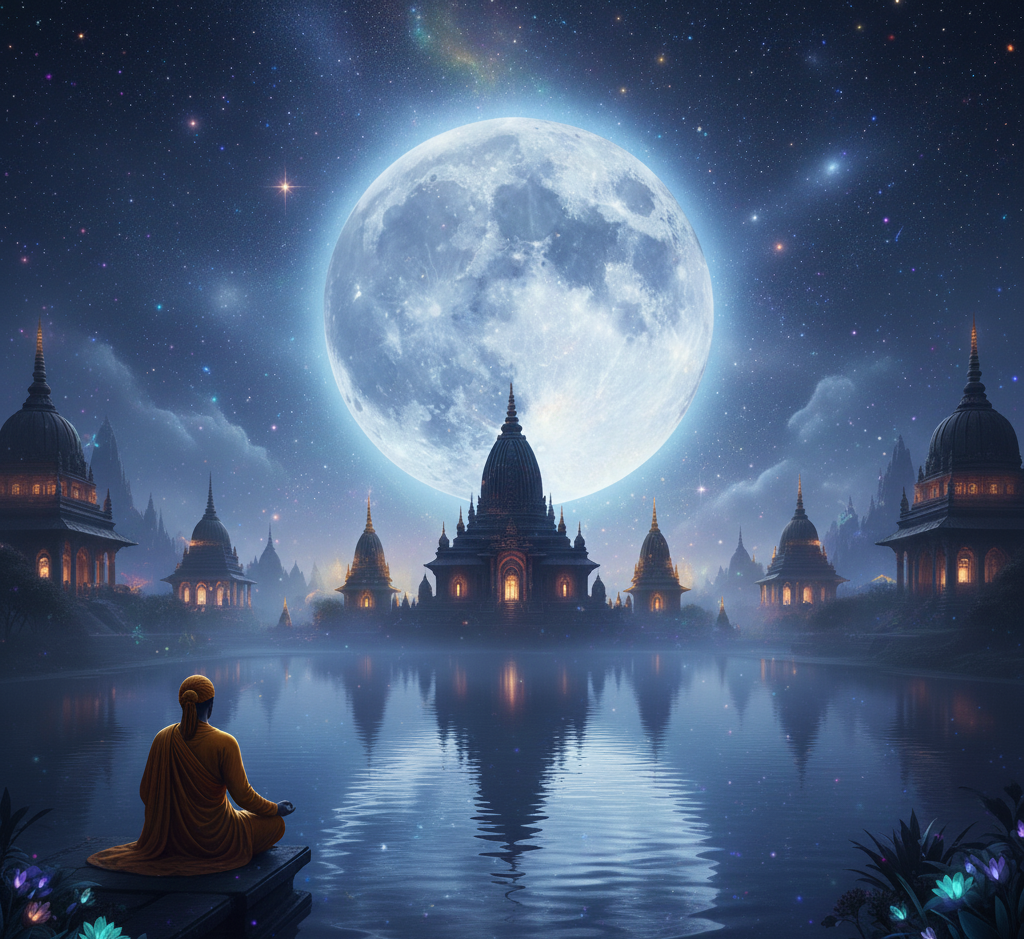
Welcome to another beautiful insight from the Time & Cosmic Cycles series.
For thousands of years, the Moon has guided human life, shaping calendars, festivals, moods, and spiritual practices. In the Indian tradition, each lunar phase carries its own meaning and energy. Among them, Purnima, the Full Moon Day, is cherished as a moment of fullness: in light, clarity, and inner balance.
In this article, we explore Purnima through ancient scriptures, simple cosmic science, and timeless wisdom.
🌕 What is Purnima?
Purnima is the Full Moon Day, the moment when the Moon appears completely bright in the night sky.
Purnima occurs when the Earth is positioned between the Sun and the Moon, and the three are almost in a straight line. This near-alignment lets sunlight fall fully on the Moon’s visible side. Interestingly, if the alignment were perfectly straight – the Moon would slip into darkness, creating a lunar eclipse. This tiny difference in angle is what turns an ordinary full moon into a monthly wonder instead of an eclipse.
In the Hindu calendar, Purnima holds deep spiritual, cultural, and symbolic significance.
🌟 What Happens on Purnima?
Purnima is the final day of Shukla Paksha, the bright half of the lunar month, when the Moon gradually grows from Amavasya to complete brightness.
On this night, the Moon’s face is fully visible, and traditionally, this is seen as a time when sattva. clarity, purity, and peace, naturally increases in the environment.
The next day begins Krishna Paksha, when the Moon’s visible portion slowly becomes smaller again as it moves toward the next Amavasya.
📜 Scriptural Roots
References to the Full Moon and its importance appear throughout the Vedas and Puranas:
- Yajur Veda: speaks of the Darsha–Purnamasa rites, monthly rituals performed on Amavasya and Purnima.
- Atharva Veda (8.10): describes Purnima as a day of fullness, clarity, and spiritual upliftment.
- Shatapatha Brahmana: connects Purnima with pūrṇatā (completeness) and auspicious ceremonies.
- Bhagavata Purana (5.21): explains how the fully bright Moon influences nourishment, vitality, and the flow of cosmic time.
These texts show that our ancestors recognised Purnima as a day of harmony and expanded energy.
🌟 Why Purnima is Significant:
🌝 A Day of Fullness and Auspiciousness
Because it represents completeness, Purnima is considered highly favourable for:
- ceremonies
- learning
- charity
- spiritual gatherings
- beginning new undertakings related to knowledge or devotion
The Shatapatha Brahmana (an ancient Vedic text of the Shukla Yajur Veda) states that whatever is complete carries a pure, balanced energy, making Purnima especially supportive for beginnings rooted in clarity and devotion.
🪔 Spiritual Practices and Upliftment
Purnima is traditionally seen as a naturally supportive time for inner practices. Many people observe:
- meditation
- mantra japa
- fasting
- satsang and listening to scriptures
🌱 The Flow of Soma and Lunar Energy
The full moon’s brightness is believed to create a calm, clear mental state. In Vedic thought, this is linked to Soma, the subtle lunar essence or nectar. On Purnima, Soma is believed to be at its fullest, nourishing and enriching:
- the waters
- medicinal herbs
- physical vitality
- the inner rasa (essence) that influences mood, clarity, and emotional balance
The Moon’s gravitational pull creates higher tides on full moon days, showing its strong influence on water. Since the human body is largely made of water, traditional wisdom sees Purnima as a time when the Moon’s effect on both nature and the mind is especially noticeable.
🎉 Major Festivals on Purnima
Some of the most important festivals fall on Purnima:
- Guru Purnima
- Sharad Purnima
- Holi (Purnima of Phalguna)
- Buddha Purnima
- Kartik Purnima
These occasions reflect the uplifting and celebratory energy that this day carries.
✨ Tatvamaya Insight
Purnima symbolises completeness, a reminder that fullness of mind and heart comes not from outward gains, but from clarity, light, and inner harmony.