What is a Lunar Month?
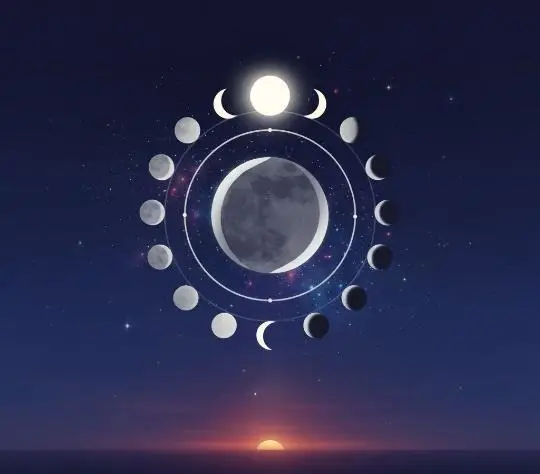
In Sanatana Dharma, time is seen as a living rhythm shaped by the sun, moon, and stars. These natural cycles form the foundation of the Hindu calendar. But for many beginners, terms like Tithi, Paksha, or Nakshatra feel confusing.
At Tatvamaya™, our purpose is to make this ancient wisdom simple and give the essence of knowledge to common people-clear, easy, and beginner-friendly.
With this intention, we are starting a series that helps you understand Sanatana Dharma in a clear and simple way, exactly as it was meant to be understood.
This series will gently explain how Hindu time works and why these concepts matter in daily life and spirituality.
Welcome to the first part of our Tatvamaya™ series on Time & Cosmic Cycles.
Have you ever noticed how the Moon changes every day? let’s look at the Moon the way our ancestors did. The Moon follows a cycle every month, and this rhythm touches our lives more than we realize. So come, let’s learn what this lunar month actually is, and how its gentle movement affects us.
What is a Lunar Month?
A lunar month, or Chandra Māsa, is one complete cycle of the Moon-from one Amavasya (New Moon) to the next. This is the traditional way time has been measured in Hindu culture since Vedic times.
Scriptural Roots
The idea of time being measured through the Moon appears repeatedly in ancient texts.
- The Rig Veda (1.25.8) refers to the Moon as māsakṛt-“the maker of months.”
- The Yajur Veda (19.7) mentions the two divisions of the month, the bright half and the dark half.
- The Taittiriya Samhita describes rituals arranged around lunar fortnights.
- Later, the Surya Siddhanta, a foundational astronomical text, gives the duration of a lunar month as approximately 29.5 days.
- The Bhagavata Purana (5.21) explains the movement of the Moon and its role in maintaining the cycle of time.
These references show that the lunar cycle was used consistently across thousands of years to organise rituals, festivals, and agricultural activities.
How a Lunar Month Works
A lunar month has 30 tithis (dates) and is divided into two natural phases:
1. Shukla Paksha (Bright Half)
Starts the day after Amavasya and continues until Purnima. During this time, the part of the Moon we see grows day by day.
2. Krishna Paksha (Dark Half)
Begins after Purnima and ends at the next Amavasya.
Here, the visible part of the Moon decreases each day.
This two-part movement of the Moon is the foundation of the Hindu calendar (Panchang).
Why the Lunar Month Matters
Our ancestors used the lunar month because it is the most observable and predictable natural cycle. It guides:
- timing of festivals
- fasts and vrata
- agricultural planning
- spiritual practices
- daily Panchang calculations
The Moon’s gradual change made it a natural indicator of subtle shifts in time and energy.
Tatvamaya™ Insight
By understanding the lunar month, we reconnect with the rhythm that the Vedas and Puranas recognised as the natural measure of time.
Note for the reader
Now that we understand the idea of the lunar month, it’s helpful to look at the many related concepts that complete the picture of Hindu timekeeping.
In the upcoming Tatvamaya™ Series on Time & Cosmic Cycles, we will explore each of these topics one by one.